
The method
Why pen and paper. Why AI second.
The toolkit is built on a small set of pedagogical decisions, each of which can be challenged. Here is what each one is and why it is what it is.
Decision one
The capacity comes first. The tool comes after.
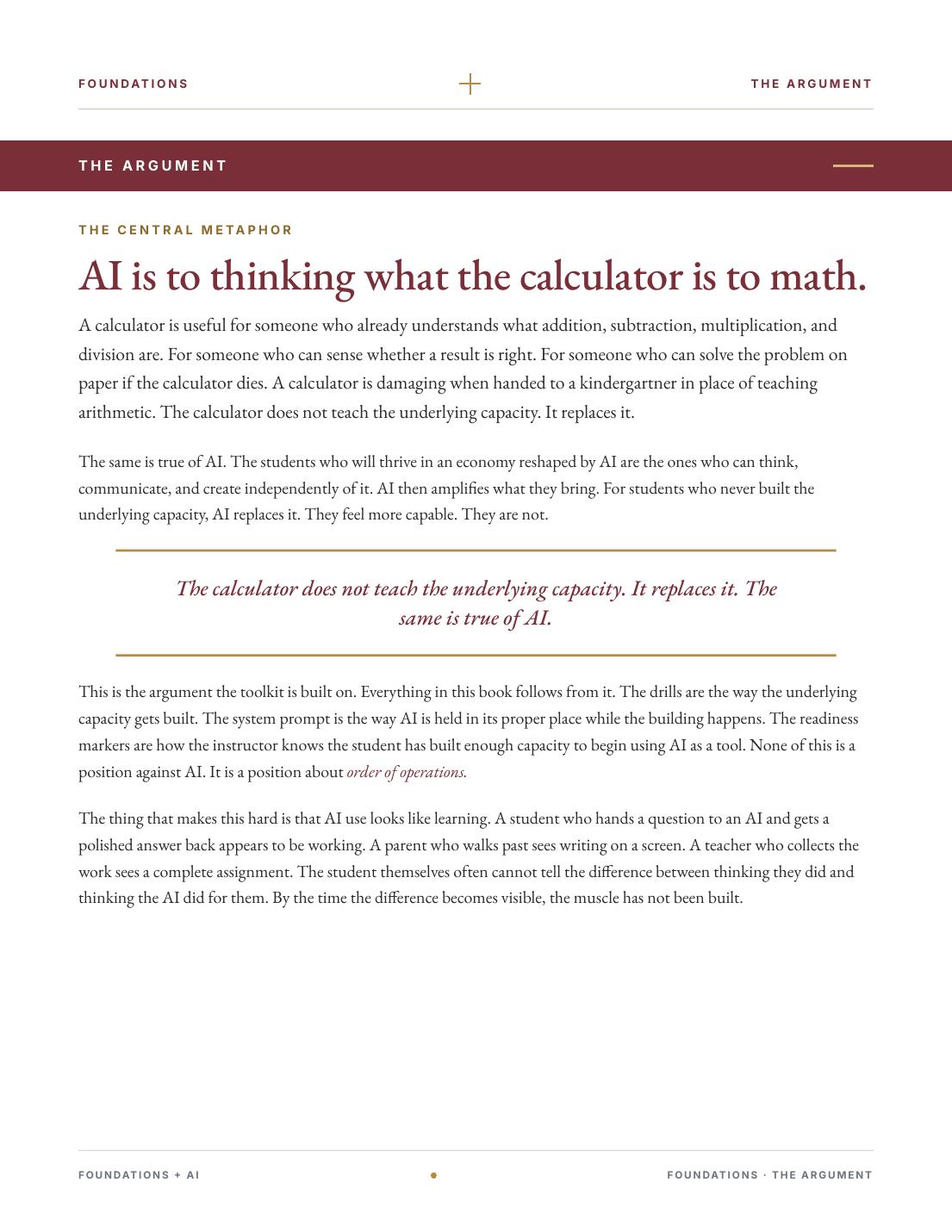
The thesis: AI is to thinking what the calculator is to math. A calculator is useful for someone who already understands arithmetic. A calculator is damaging when handed to a kindergartner in place of teaching it. The same is true of AI.
The student who can think, communicate, and create independently of AI will use AI well. AI amplifies what they bring. The student who never built the underlying capacity will use AI as a replacement. They will produce work that looks complete. They will not be able to defend a single line of it under questioning.
The first job of this toolkit is to refuse the substitution. The second is to teach the use. The order is not negotiable.
The Argument · Front matter
For students who never built the underlying capacity, AI replaces it. They feel more capable. They are not.
Decision two
AI plays four roles. Three of them, the toolkit names.
Most curricula treat AI as one thing. It is not one thing. The role changes by drill and by skill stage. The toolkit is explicit about which role is in play.
Antagonist
The thing the student must resist. In early Thinking drills, the AI tool stays closed. The capacity to sit with discomfort, to not reach for a tool, is itself the muscle being built.
Sparring partner
The thing the student questions back. In mid-toolkit drills, the AI offers a position. The student reads it, evaluates it, finds the seams, and writes a counter on paper. The AI is doing pushup reps for the student.
Supervised tool
The thing the student uses, with adult supervision and a system prompt that holds it in line. This is what the AI Extension is, in every drill. Bounded prompt, three returned questions, then the student writes by hand.
Eventual multiplier
The thing the student wields. This role is the destination, not the curriculum. It is the role the student grows into after the underlying capacity is built. By the end of the toolkit, the student knows what AI is good for and what it cannot do.
Decision three
Six drill modes. Each one teaches a different move.
A drill is a focused practice session on one small skill. A drill mode is the shape that practice takes. Six modes carry the toolkit.
Observation
Notice what is in front of you. Name it specifically enough that another person can picture it. Five Minutes at a Window is the canonical example.
Revision
Take a draft, in your own writing, and improve it. Find the line that does the most work. Find the line that does none. Cut, sharpen, replace.
Comparison
Hold two things up next to each other. Name what is the same. Name what is different. Build the muscle of distinction.
Construction
Make something that did not exist before, from constraints. A six-word story. A fifty-word definition. A page that explains a concept to a fifth-grader.
Defense
Take a position. Hold it under questioning. Answer in writing, not in conversation. The student commits in ink and learns what their actual view is.
Performance
Deliver the work to a real audience. Read it aloud. Hand it to a sibling. Mail it to a grandparent. The page is no longer private. The page is now received.
Decision four
Same spine. Every drill.
Variety is the drill mode. Consistency is the spine. Every drill, regardless of mode, follows the same six-element architecture. After running three drills, the student knows the rhythm. They are no longer learning the format. They are doing the work.
The instructor knows where to look on every page. Cover. Setup. Choice point. What good looks like. What slop looks like. How it lands. The pages are different. The bones are the same.
-
The cover
One page. Drill number, mode, title, subtitle, and the specs band: time, pages, materials, AI.
-
The setup
What gets put in front of the student. Models of what good looks like. Models of what slop looks like.
-
The doing, with the choice point
The work itself. One named moment where the student must commit. The choice point is the drill.
-
What good looks like
A specific concrete description. Not "be thoughtful." Something the student can see in their own work.
-
What slop looks like
The honest counter-example. The shape of the failure mode the student is most likely to fall into.
-
How it lands
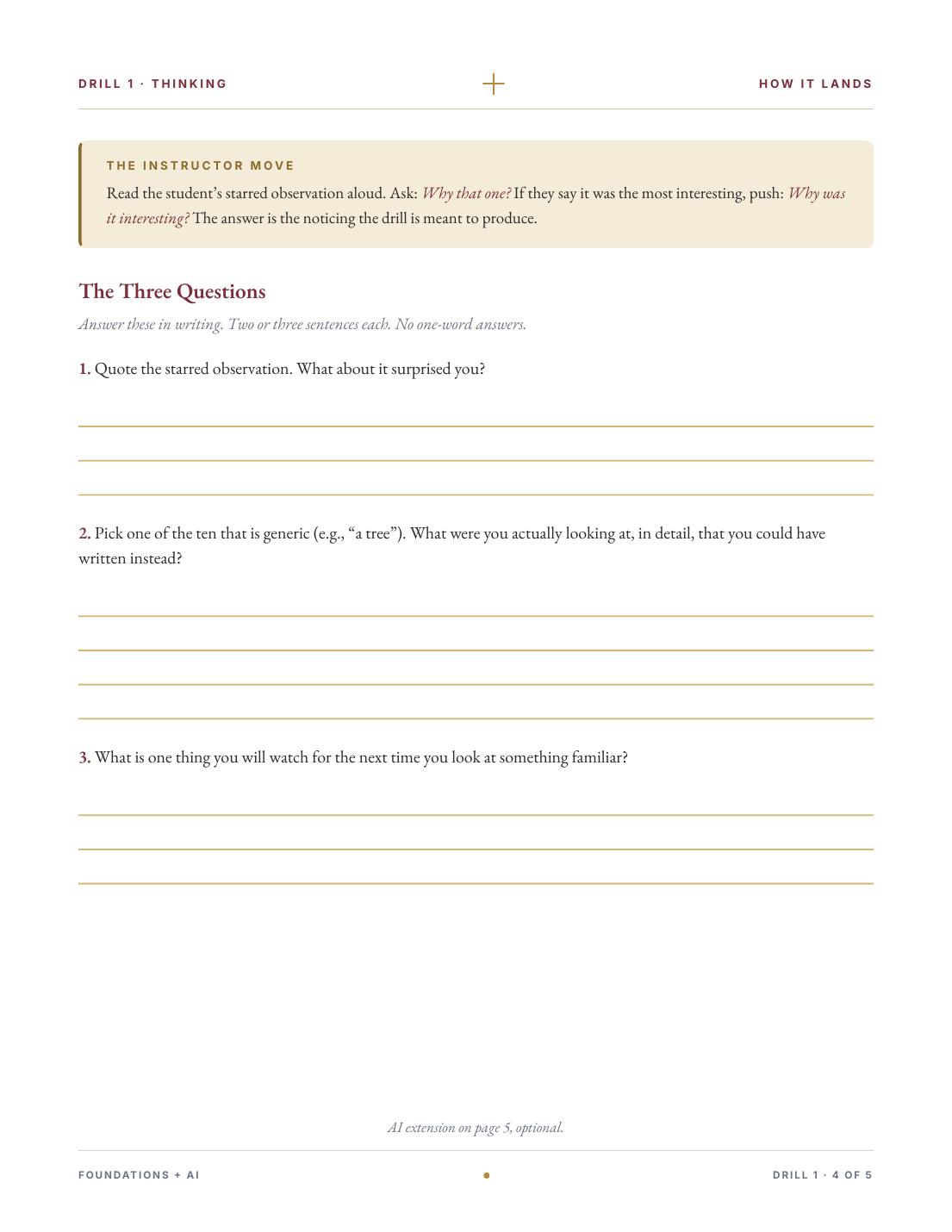
The Three Questions. Each one answered in writing, two or three sentences, by hand. Then the optional AI Extension.
Decision five
Every drill ends with three written questions.
This is the closing instrument. Three questions, every time. The student writes the answers in pen, in two or three sentences each, on lines printed on the page.
No yes-or-no questions. No one-word answers. No talking the answer out loud and skipping the writing. The instructor's job is to ask, hold the silence, and accept whatever the student writes. Including "I dunno", which is itself a piece of data.
Writing is what makes the thinking real. Spoken answers can be vague and feel done. Written answers force commitment. The page does not let the student wave their hands.
If the student writes "I dunno," the instructor accepts it, names what they see, and asks the next question. The toolkit has a chapter on what to do with this. It is not a failure. It is a starting point.
How It Lands · The Three Questions
Decision six
The system prompt holds the line.
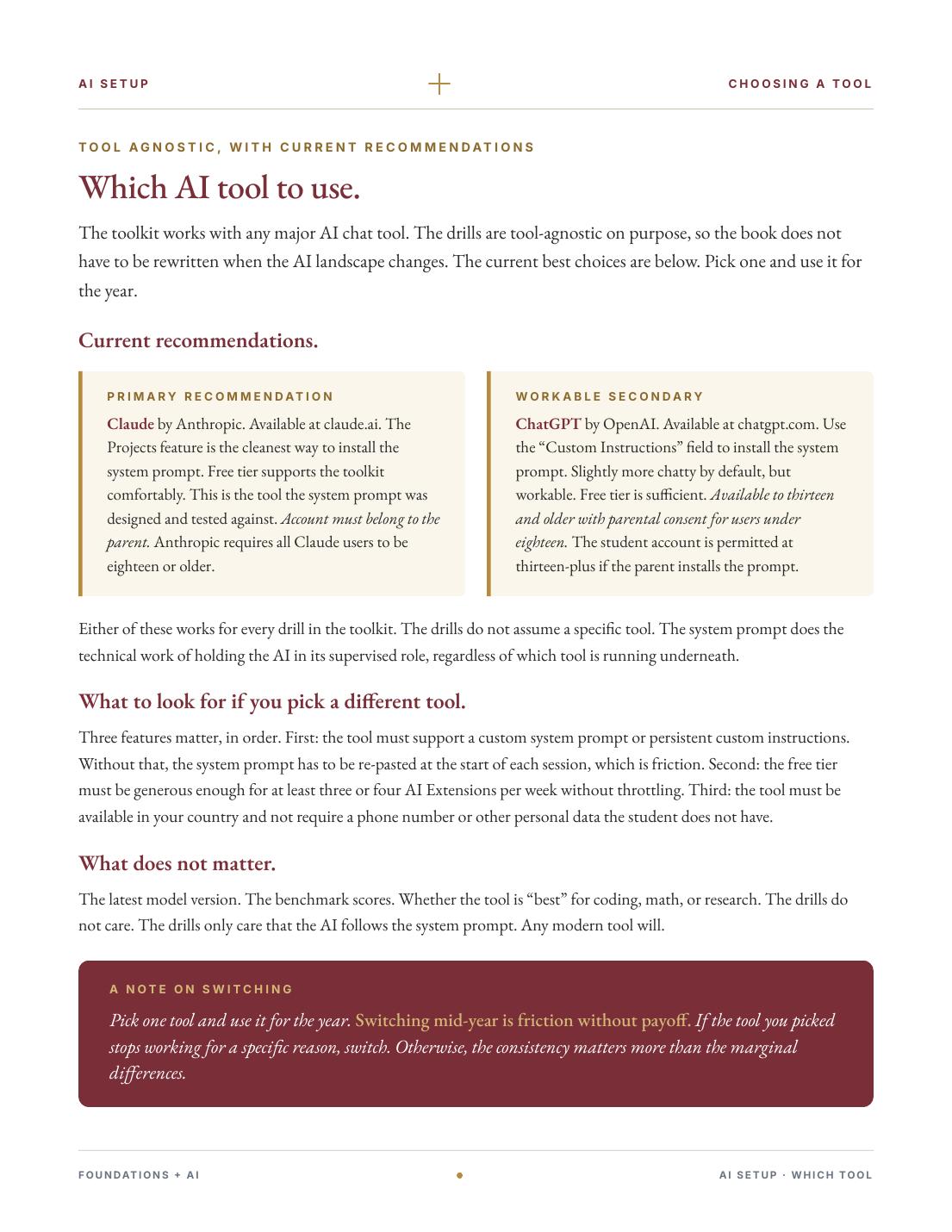
Every AI Extension assumes the AI tool has been set up correctly. The setup is one-time and takes about twenty minutes. The toolkit gives you the system prompt to paste into the tool's project feature.
From that point on, the AI refuses to do the student's work. It refuses to generate paragraphs of writing. It refuses to make images. It asks one question at a time, not five. It returns three questions when the drill specifies three. It stays inside the four-step workflow. It calls itself out when it slides off-prompt.
The chapter also gives you a verification ritual. After setup, the student tries to make the AI break the rules. They ask it to write the paragraph for them. They ask it to draw the picture. The AI refuses. The student sees that the rules hold. Then the work begins.
AI Setup chapter
Decision seven
Readiness markers, not weeks.
The toolkit is unsequenced on purpose. There is no "Week 4: Lesson 12." There is no pacing calendar. There is no end-of-year exam.
Instead, the toolkit names readiness markers. The student can sit with a question for sixty seconds without reaching for a tool. The student can write three sentences about a starred observation without coaching. The student can read an AI response and identify one thing wrong with it. Markers live in the section essays. The instructor watches for them.
Some students hit a marker in three drills. Some take fifteen. The clock is not the curriculum. The capacity is the curriculum.
Pedagogical lineage
This is not a new method. It is a synthesis.
Foundations + AI takes practices that have worked for a hundred years and rebuilds them for the moment AI arrived.
Lineage 1
Charlotte Mason narration
Reading something, then producing it back in the student's own words, has been part of the home-education tradition since the late nineteenth century. The Three Questions are a rigorous narration step.
Lineage 2
Classical rhetoric
The progymnasmata sequence taught fable, narrative, comparison, and refutation as graded exercises. The drill modes are a modern shape of the same idea: bounded practice on bounded skills.
Lineage 3
Sports drill methodology
Coaches do not teach footwork by playing a game. They isolate the move, repeat it under varied conditions, then return it to the game. The toolkit borrows the structure and the language.
Plus the writing workshop tradition: short bounded prompts, multiple drafts, the public reading at the end. The Performance mode is a direct descendant.
Method made physical
Read it once. Run a drill on Tuesday.
$97 USD. Single household. The Quick-Start Guide takes ten minutes. The first drill takes twenty-five.