
Inside the book
395 pages, walked through. Look before you buy.
Most product pages show you a cover and ask you to trust them. We are showing you the front matter, the Quick-Start Guide, the section openers, a full drill, the AI Setup chapter, and the standards page.
The cover
A book, not a workbook.
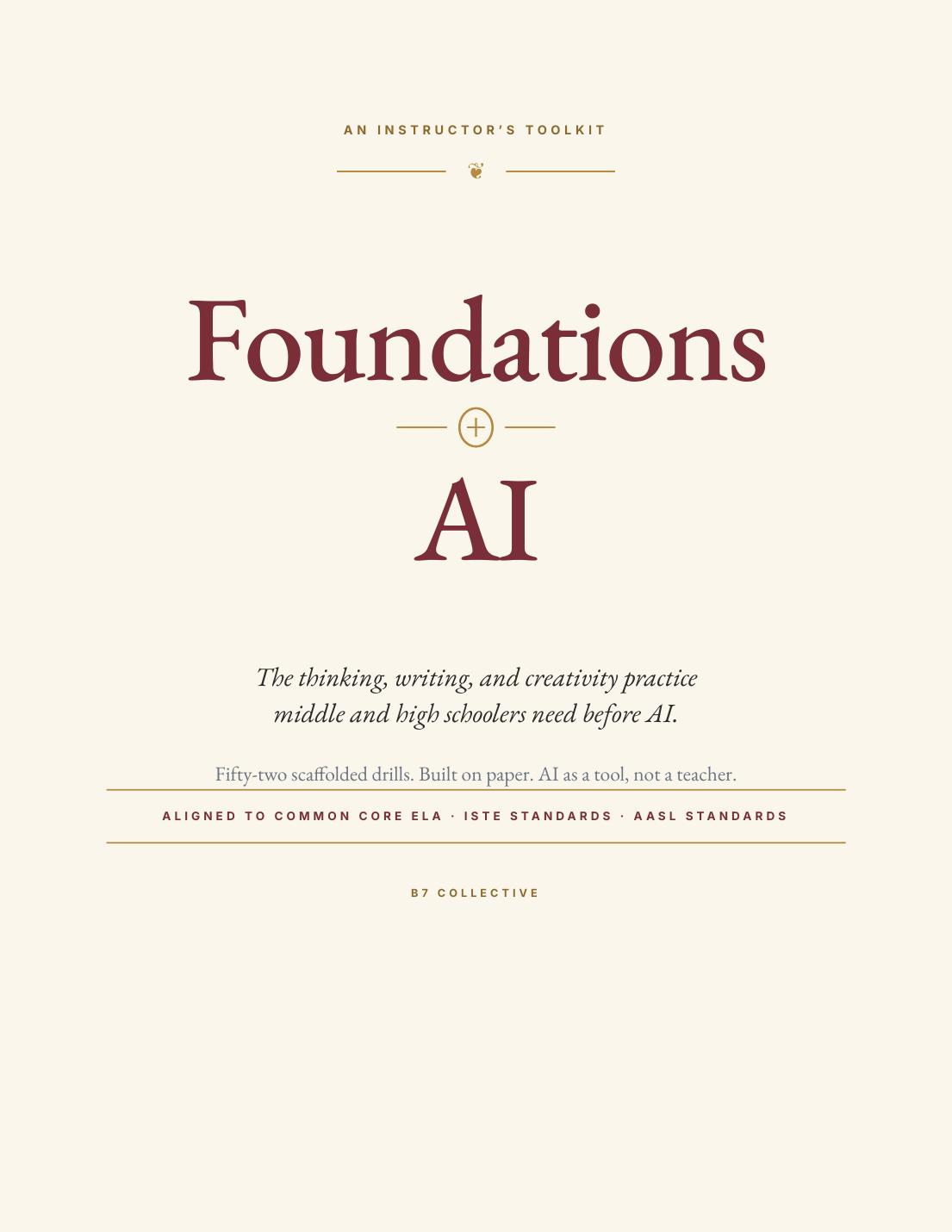
The cover is set in EB Garamond, the typeface of well-made literary publishing. It is the same typeface used by Knopf, Riverhead, Yale University Press, and the New York Review of Books. It is essentially never used in school curricula. That is the point. This is not a workbook with a brand-new edition every fall. It is a single book you buy once.
The maroon and gold palette places the toolkit on the bookshelf alongside literary publishers, not corporate education products. The center mark is a circled gold plus, the brand icon. The plus connects the foundations above to the AI below.
Front cover
Contents
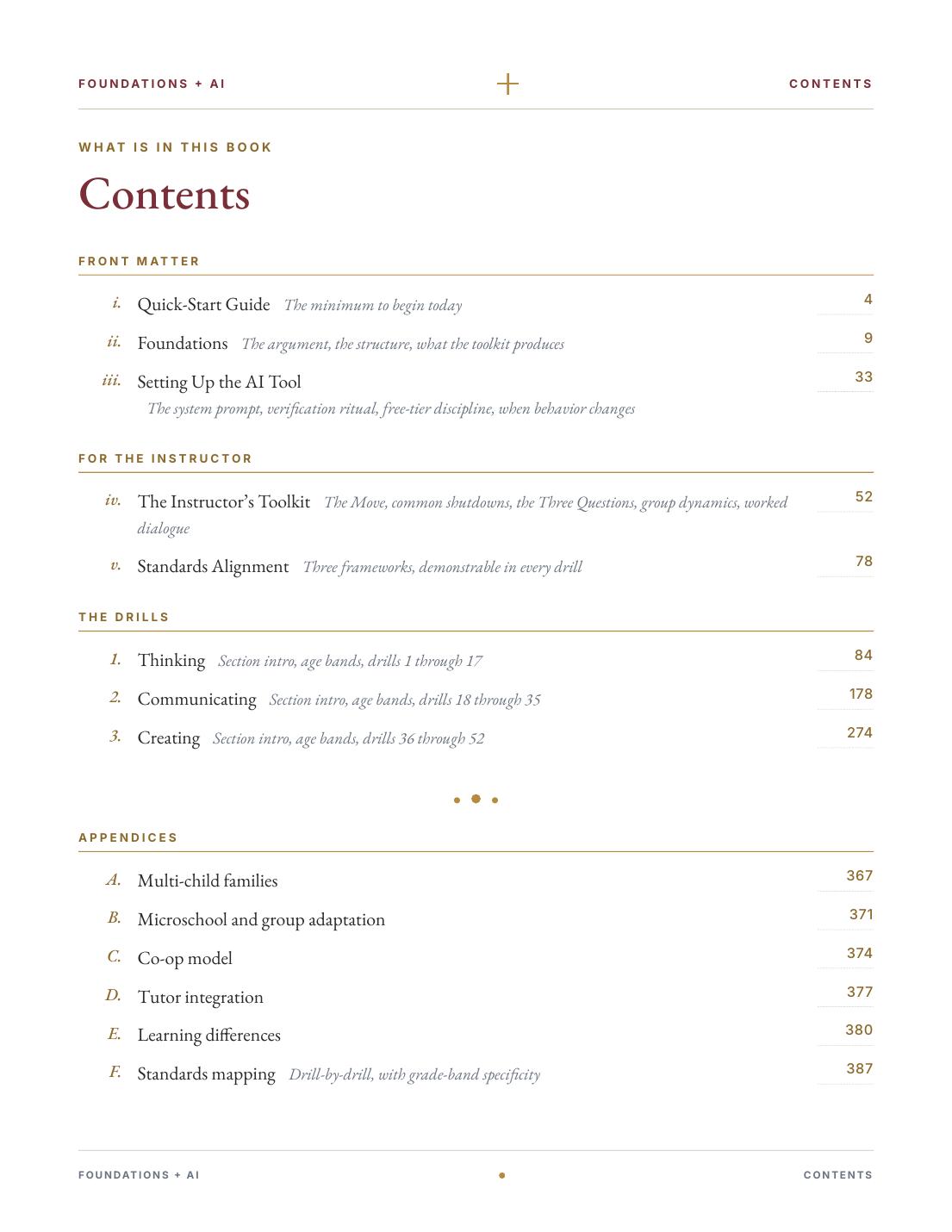
Five blocks of work.
Front matter explains the argument and gives you the Quick-Start Guide. The instructor sections cover your job and standards alignment. The drills are the bulk of the book. Appendices handle the cases where this looks different from the kitchen-table default.
Read it straight through if you want. Or skip to the Quick-Start Guide and run a drill in twenty minutes from now.
Page 3 · Contents
Front matter
Three chapters before the drills.
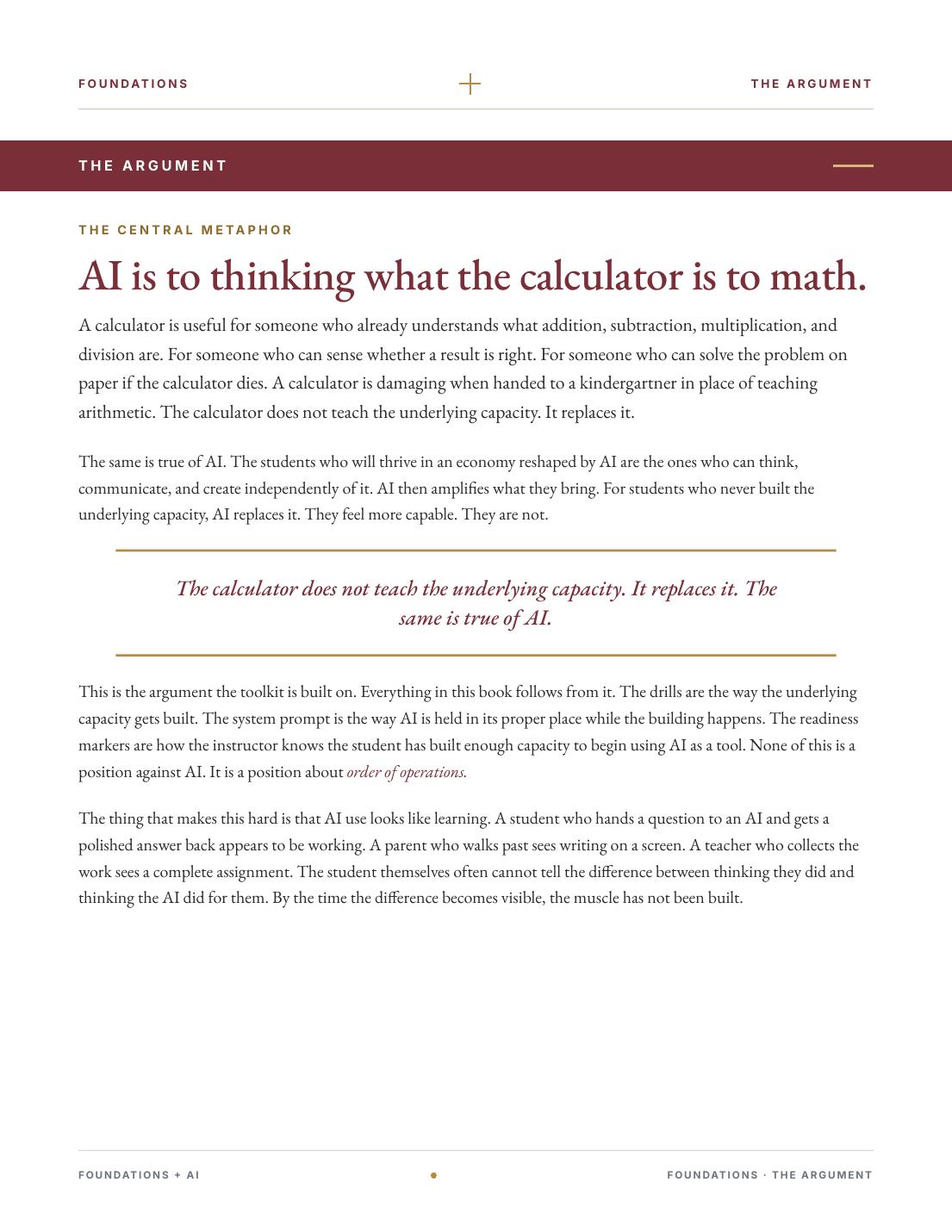
The Quick-Start Guide. The Foundations chapter, where the argument lives. The AI Setup chapter, where the system prompt lives.
Quick-Start · Page 1 of 4
Foundations · The argument
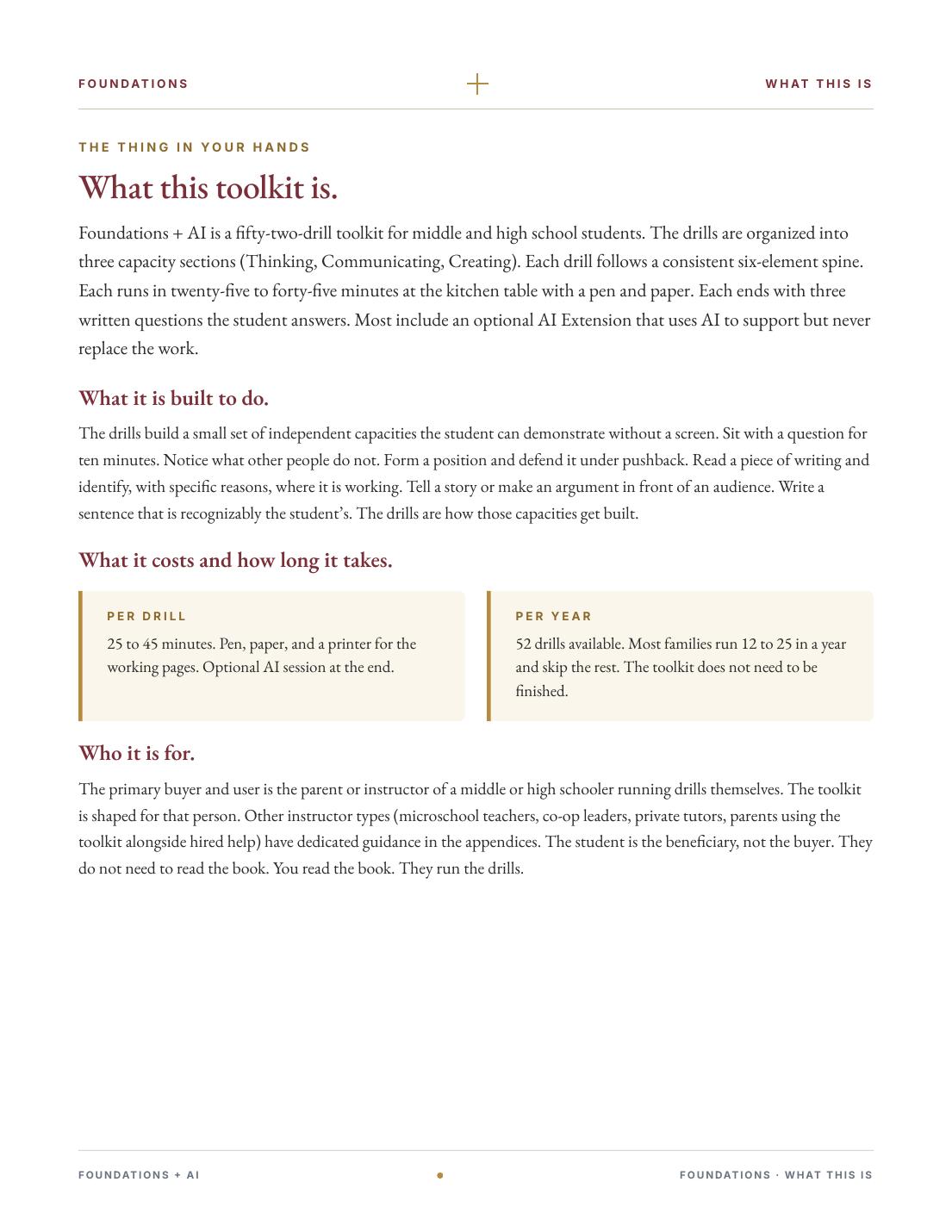
Foundations · What it is
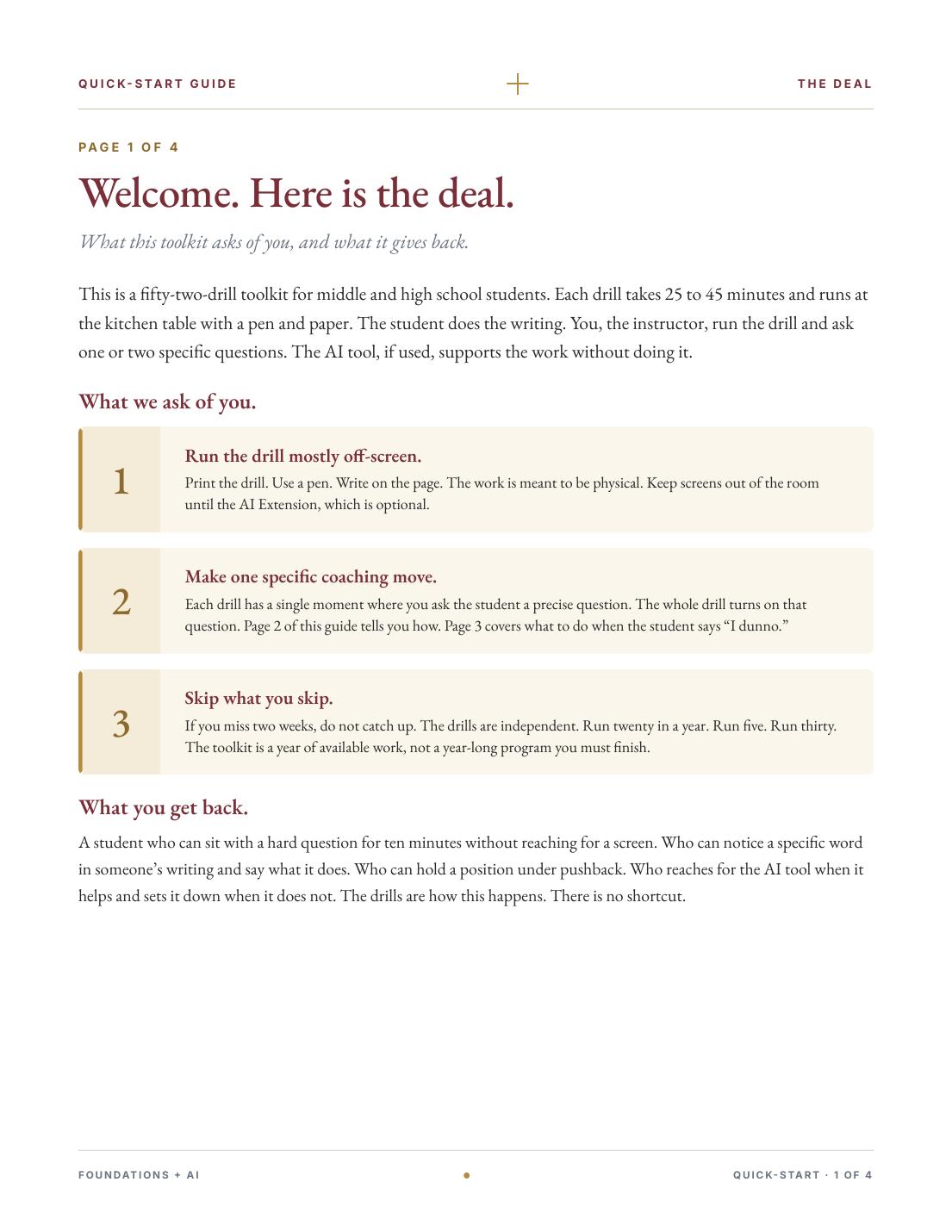
The Quick-Start Guide is four pages. Most parents start here.
Get the toolkit · $97Section 1 · Thinking
A muscle, not a talent.
The Thinking section opens with an essay before the drills begin. Roughly five pages. Written for the student, read first by the instructor.
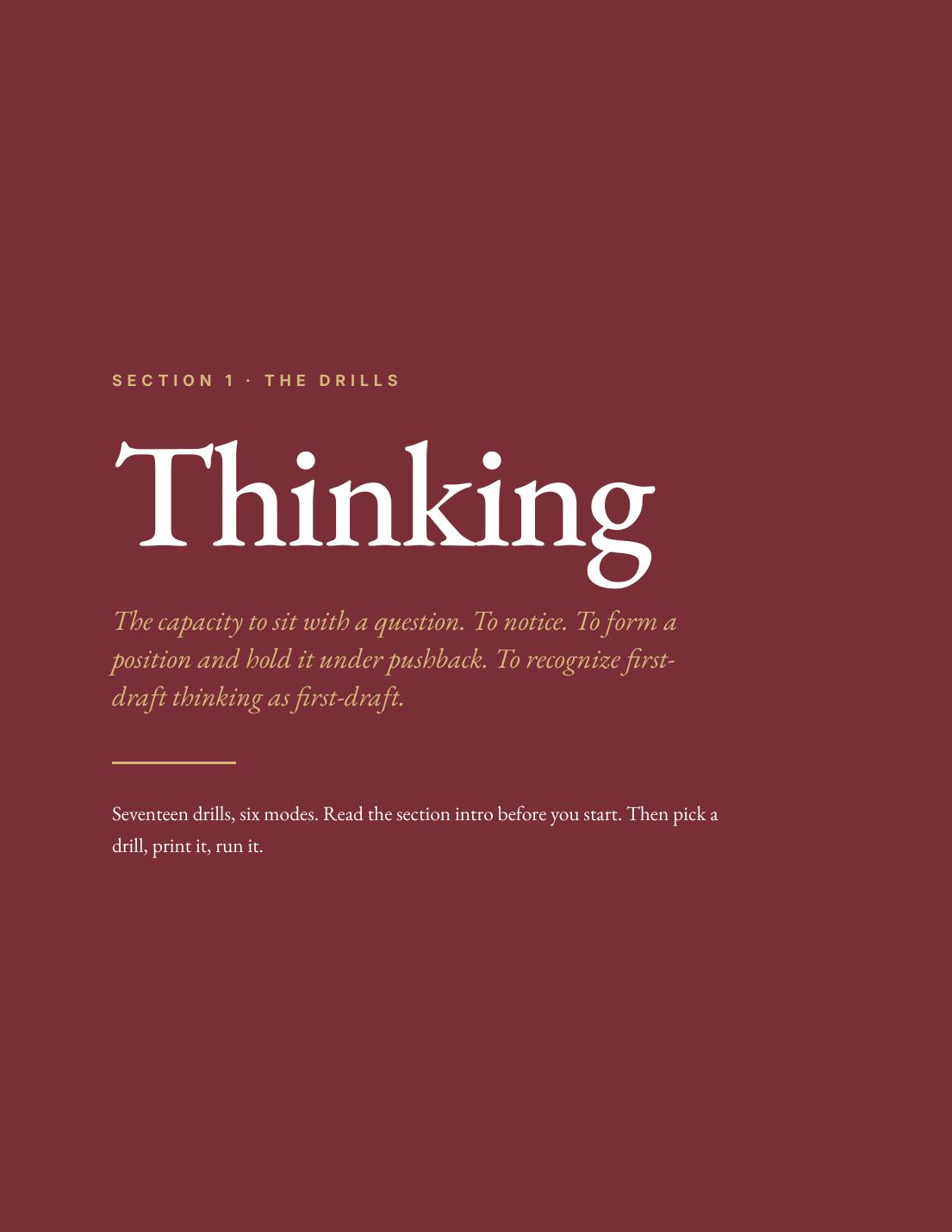
Section opener
Each capacity section begins with a six-component intro essay. What this capacity is. Why it matters in the AI age. What strong thinkers, communicators, or creators actually do. Three named pitfalls. Five tips the student can use tomorrow. A bridge into the drills.
The essays are written for the student in clear, direct prose. The instructor reads them first to know what the bar is. Then the student reads them, or you read them aloud together. Then the drills begin.
The Thinking essay, page by page.
Five pages. The first defines the capacity. The next names three pitfalls and the strong move that beats each one. The next gives the student five short habits to try this week. The last is the age-band reference page.
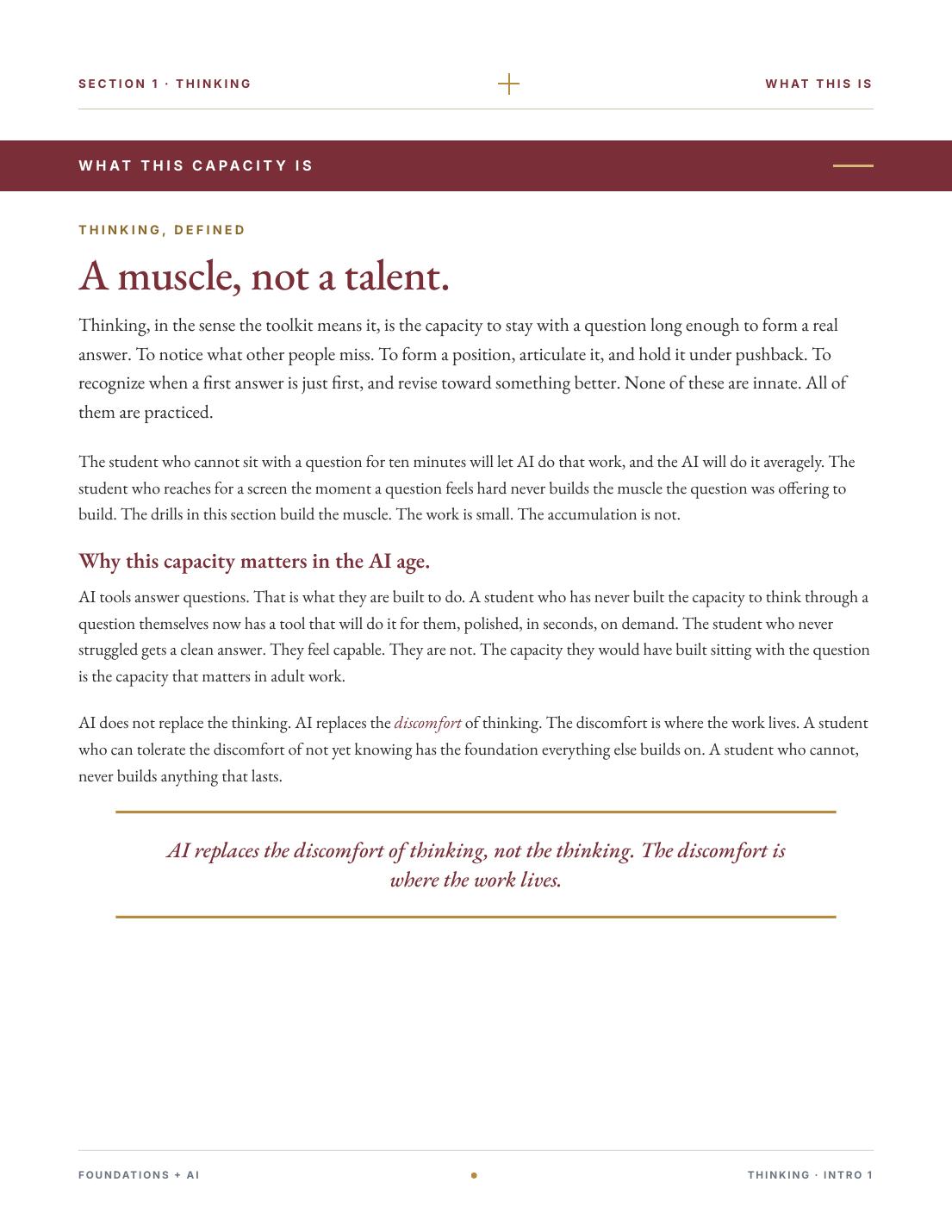
Page 1 · What thinking is
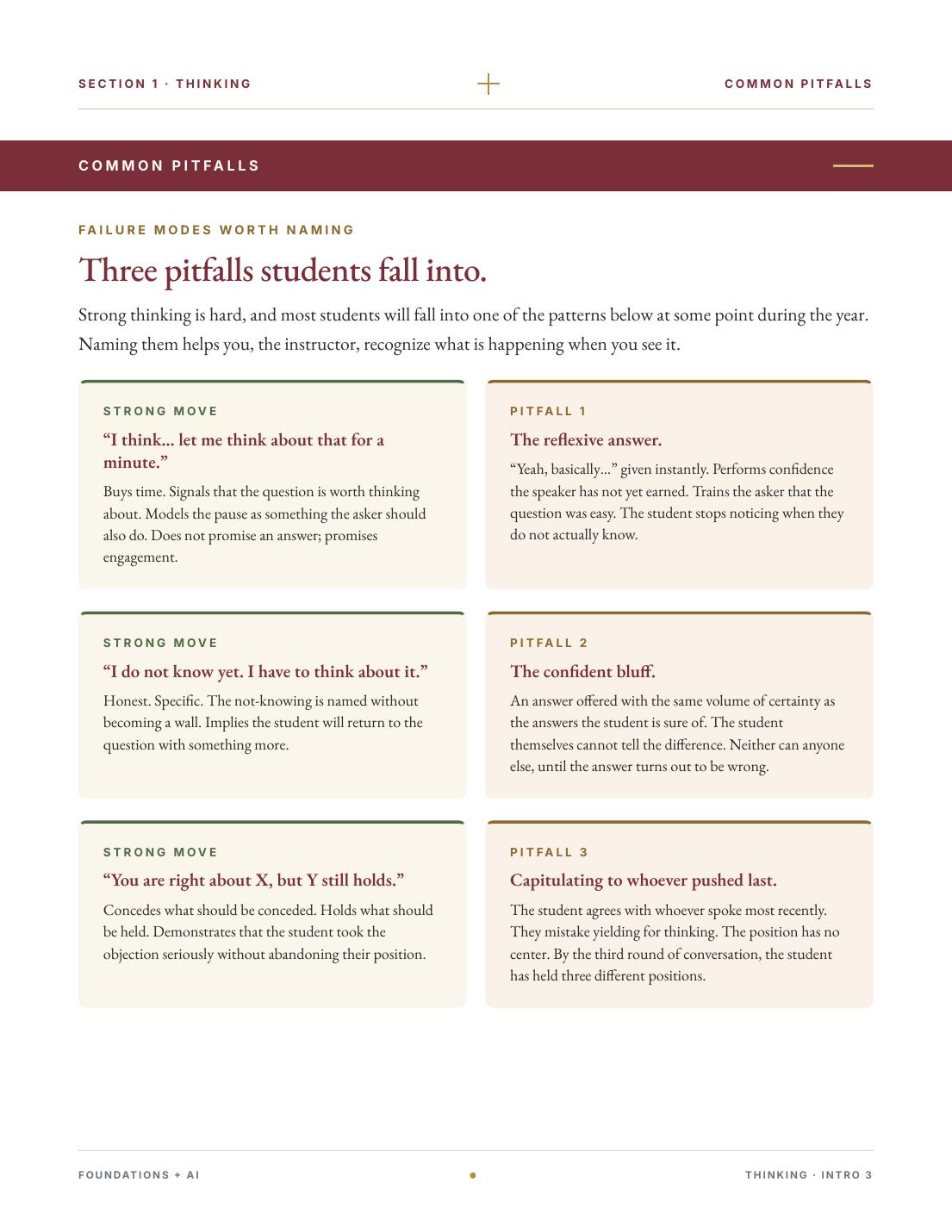
Page 3 · Pitfalls and strong moves
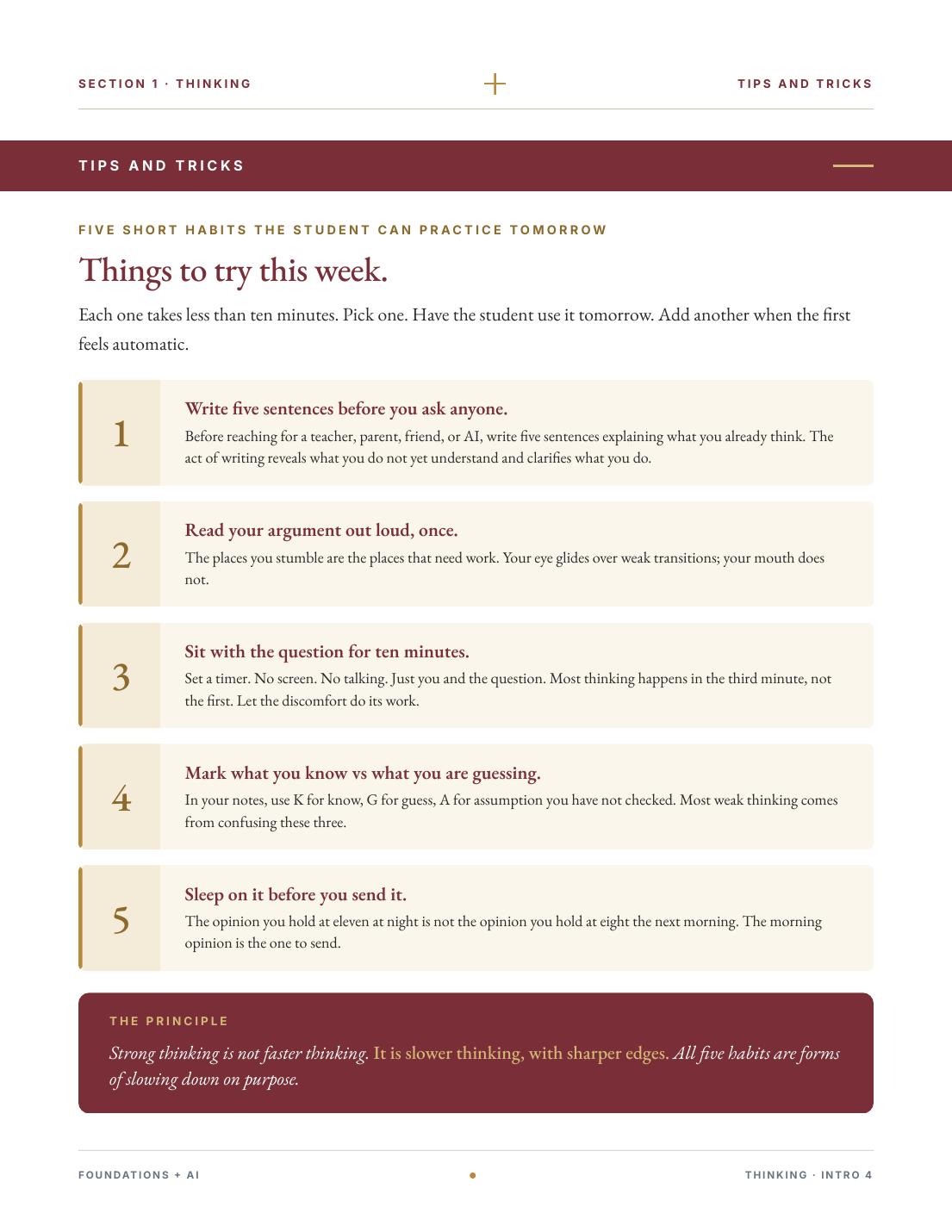
Page 4 · Things to try this week
Then, the age bands.
Each capacity has its own age-band markers. Eleven to thirteen. Fourteen to sixteen. Seventeen to eighteen. The bands name what strong work looks like at three developmental stages.
The bands are guides, not gates. A student works at whichever band fits their actual capacity, which may or may not match their birthday. If a drill is too easy, it stops being productive. If a drill is too hard, the student collapses into "I dunno." The age bands let you calibrate which drills to start with.
Strong thinking is not faster thinking. It is slower thinking, with sharper edges. All five tips are forms of slowing down on purpose.
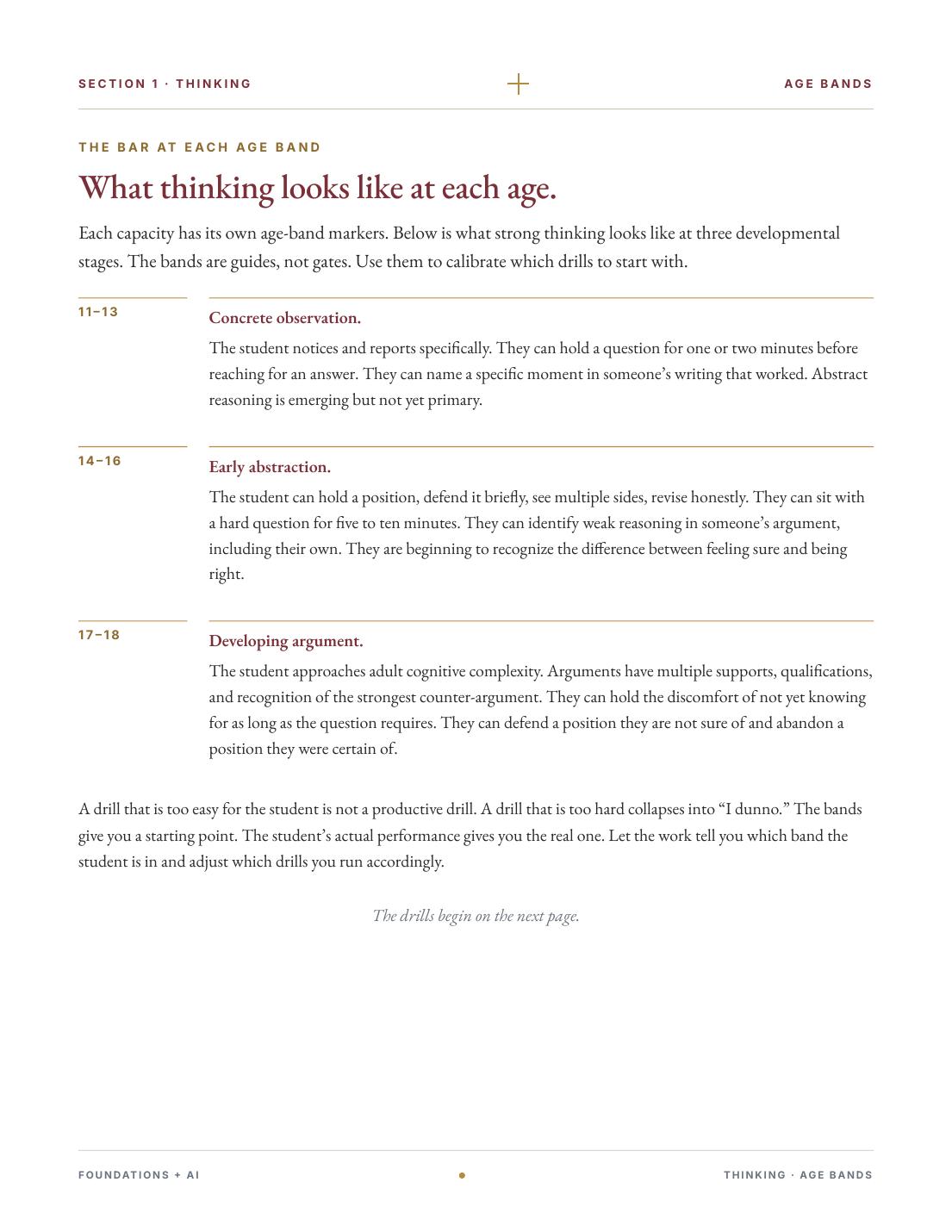
Page 5 · Age bands reference
Sections 2 and 3 · Communicating and Creating
The same shape. Different work.
Each section opens the same way. Maroon page. Single word. Italic capacity definition. Then the essay. Then the drills.
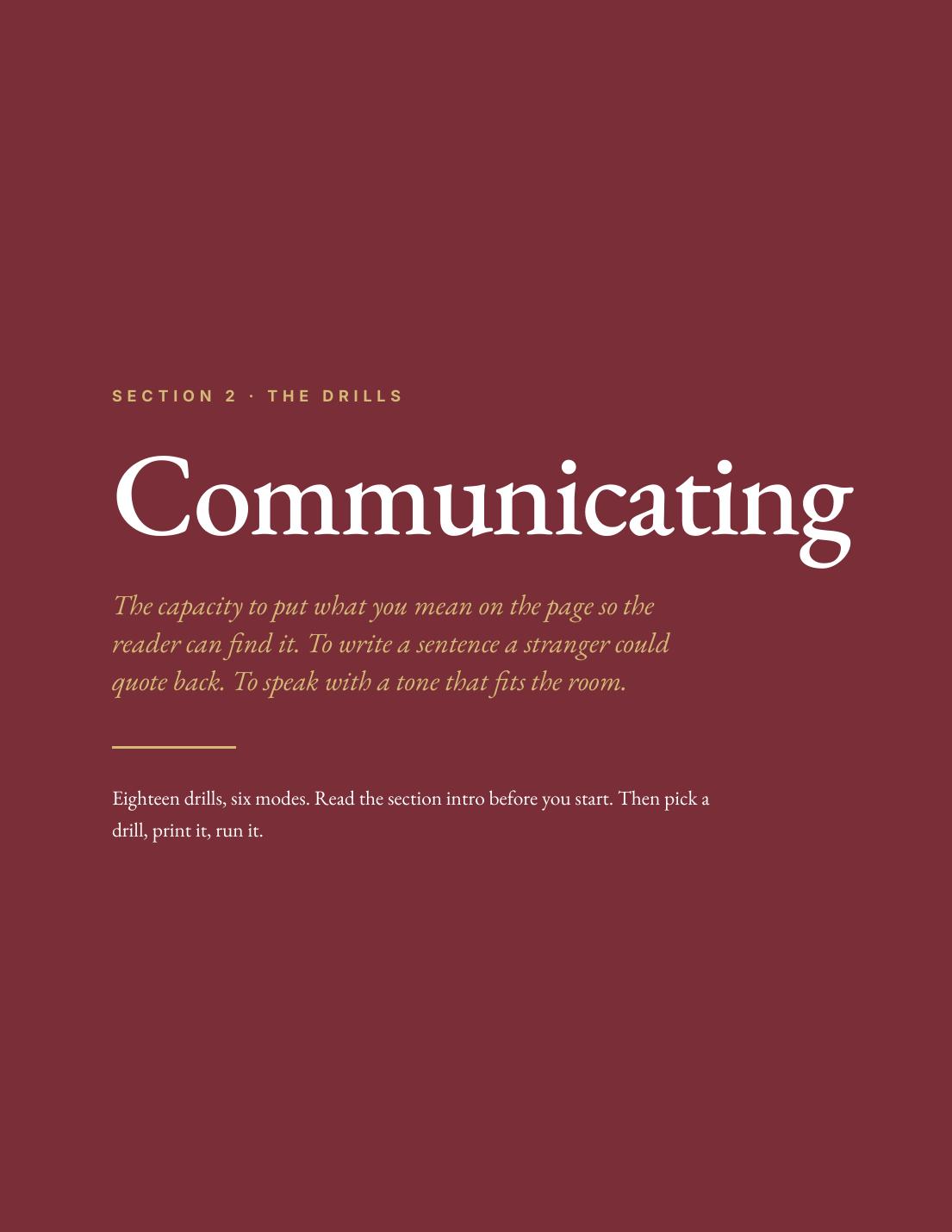
Section 2 · Communicating · 18 drills
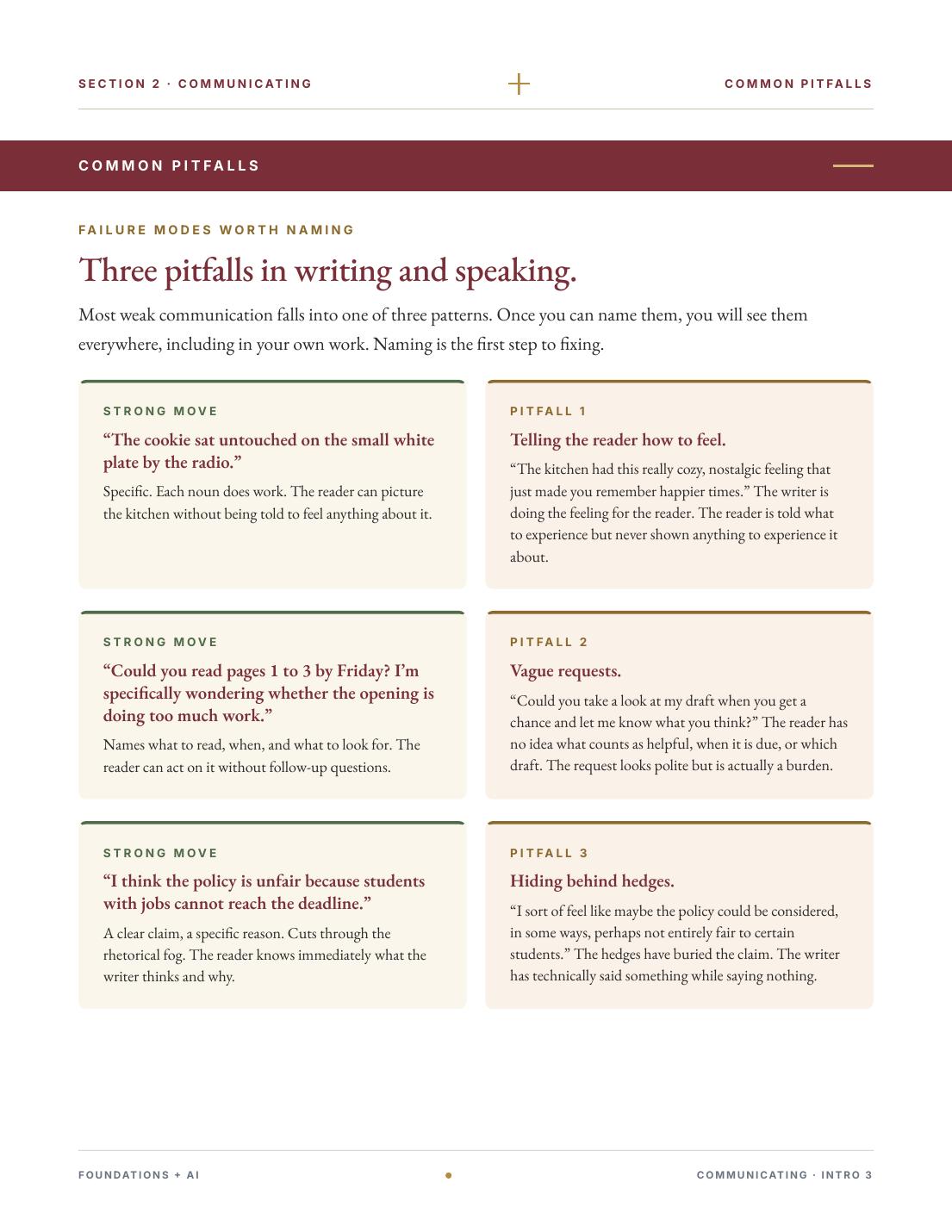
Communicating · Pitfalls page
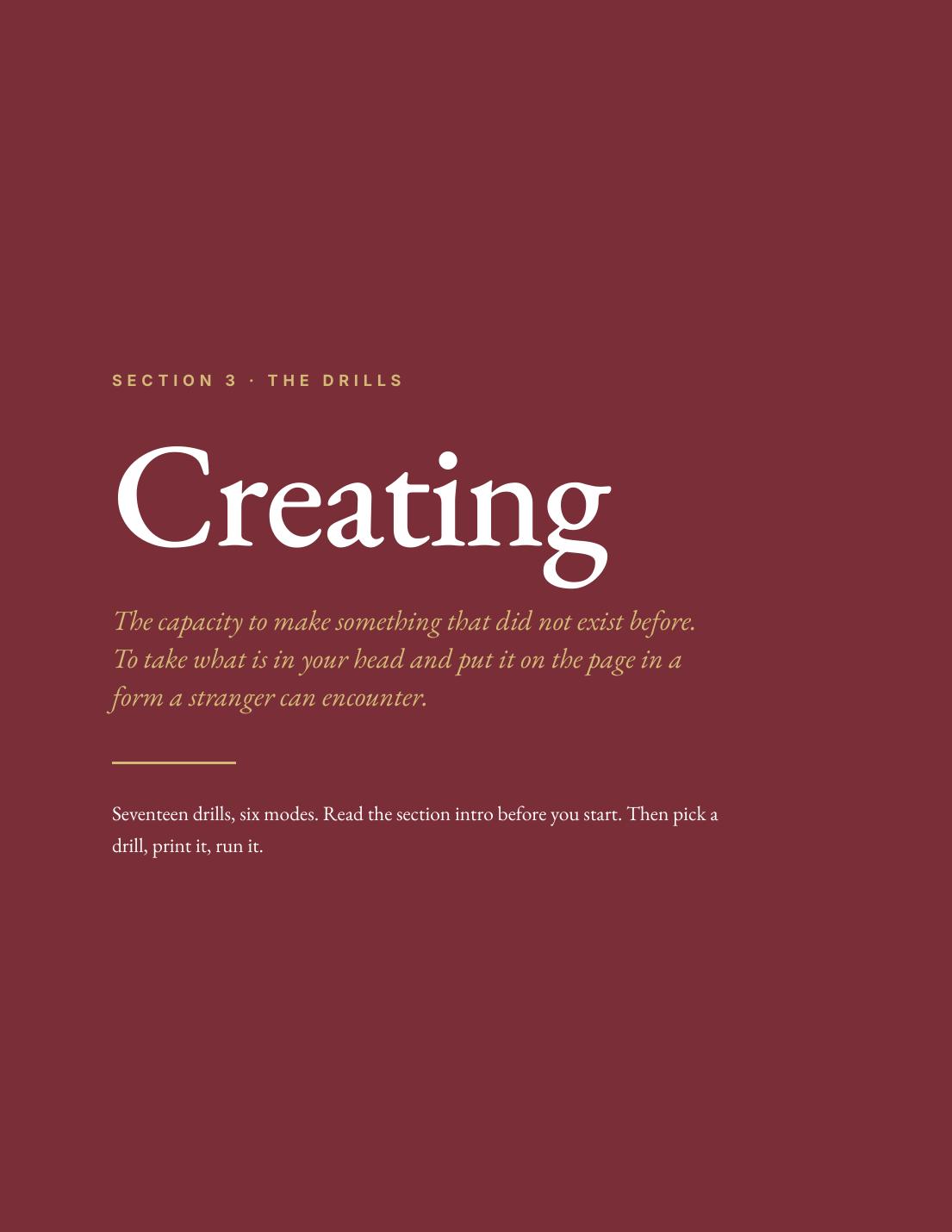
Section 3 · Creating · 17 drills
Variety, by design
No two drills are the same shape.
The variety rule, locked in production: no drill may be a structural copy of any other drill in the same mode. Within a mode, consecutive drills must differ in at least three of seven dimensions. Choice point structure. Work-product format. Work-page format. Content domain. Time scale. Level of physical activity. Level of social interaction.
If three dimensions of difference cannot be identified, the drill is too similar to one already in the book. The drill gets rebuilt or replaced.
A drill, end to end
Five Minutes at a Window. Five pages.
Drill 1 of 52. Observation mode. The first drill in the Thinking section. Twenty-five minutes. Pen and paper. Optional ten-minute AI session at the end.
The cover.
Every drill starts with a cover page. Drill number out of fifty-two. Mode treatment between two gold rules. Title in EB Garamond at 48 points. A short subtitle that names what the drill is doing. The description. The specs band: time, pages, materials, AI.
Print this page first. Confirm you have what you need. Take ninety seconds to read it with the student. Then step away and let them work.
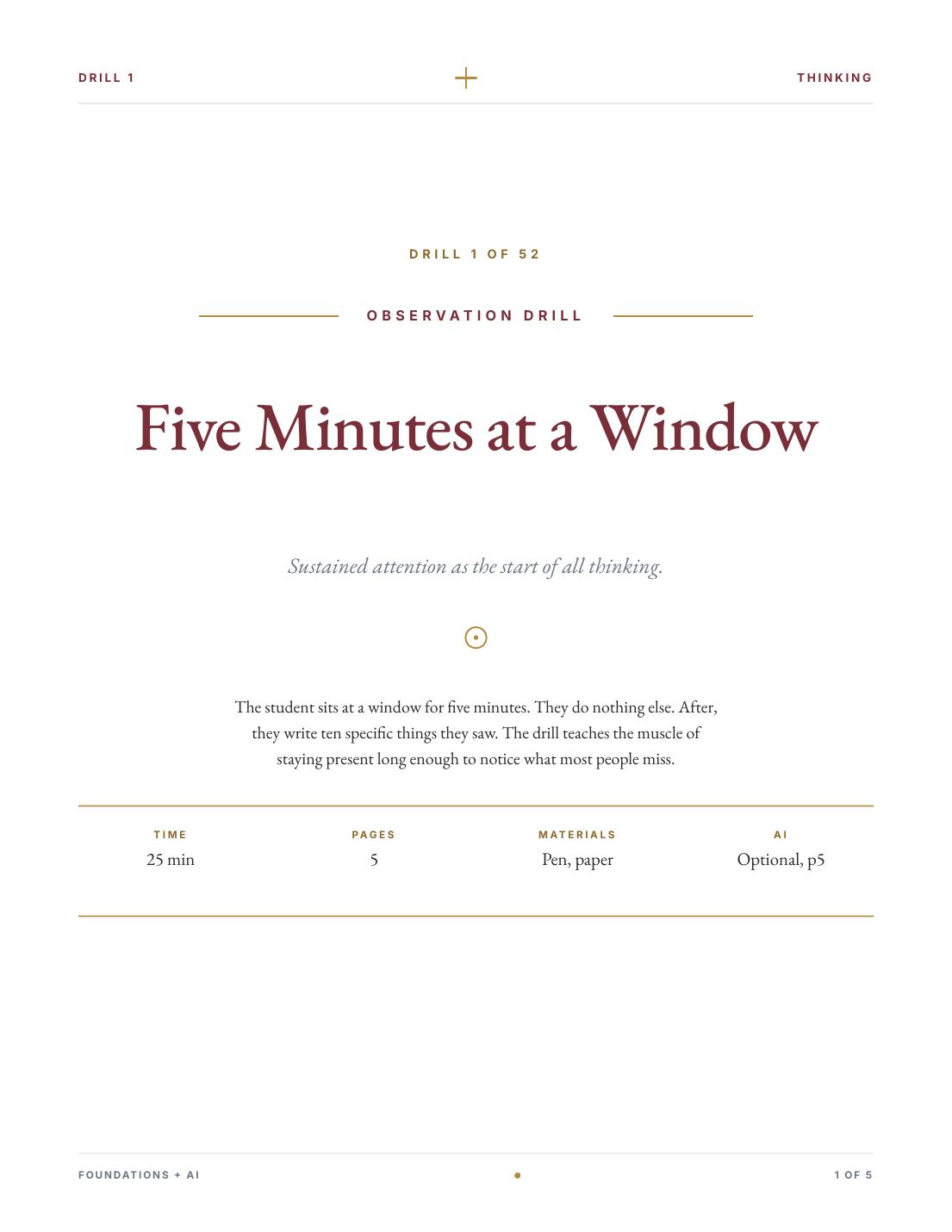
Page 1 of 5 · Cover
The setup, then the doing.
The Field is the section band that opens an Observation drill. Two cards model the difference between a strong observation and a generic one. "A red truck idling at the corner with the driver-side mirror folded in" is specific. "A truck on the street" is generic.
The Doing names the steps. The choice point sits in a callout with a gold left rule. One of your ten observations will surprise you. Mark it with a star. The starred one is the one that did the work. Naming it is the drill.
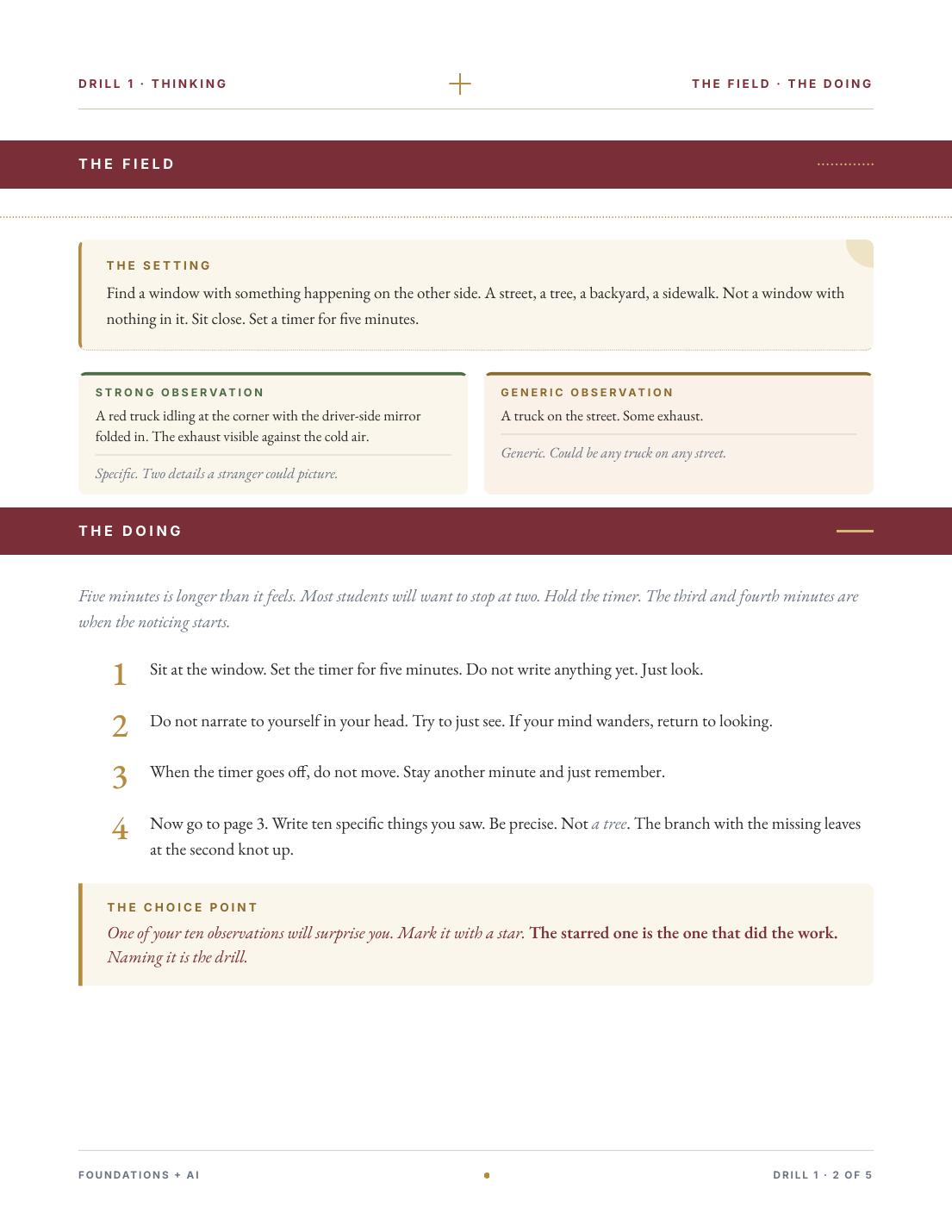
Page 2 of 5 · The Doing
Three Questions. Always.
Every drill ends with three written questions. None of them accept yes or no. Each has a minimum number of writing lines beneath it: three for question one, four for question two, three for question three. The student writes by hand. The lines are gold-light, the color the eye reads but the page does not shout.
The questions in this drill ask the student to quote the starred observation, name what surprised them, find one of the ten that was generic and rewrite it specifically, and commit to one thing they will watch for the next time they look at something familiar.
No yes-or-no questions in the closing instrument. Two or three sentences each. No one-word answers. The student writes by hand.
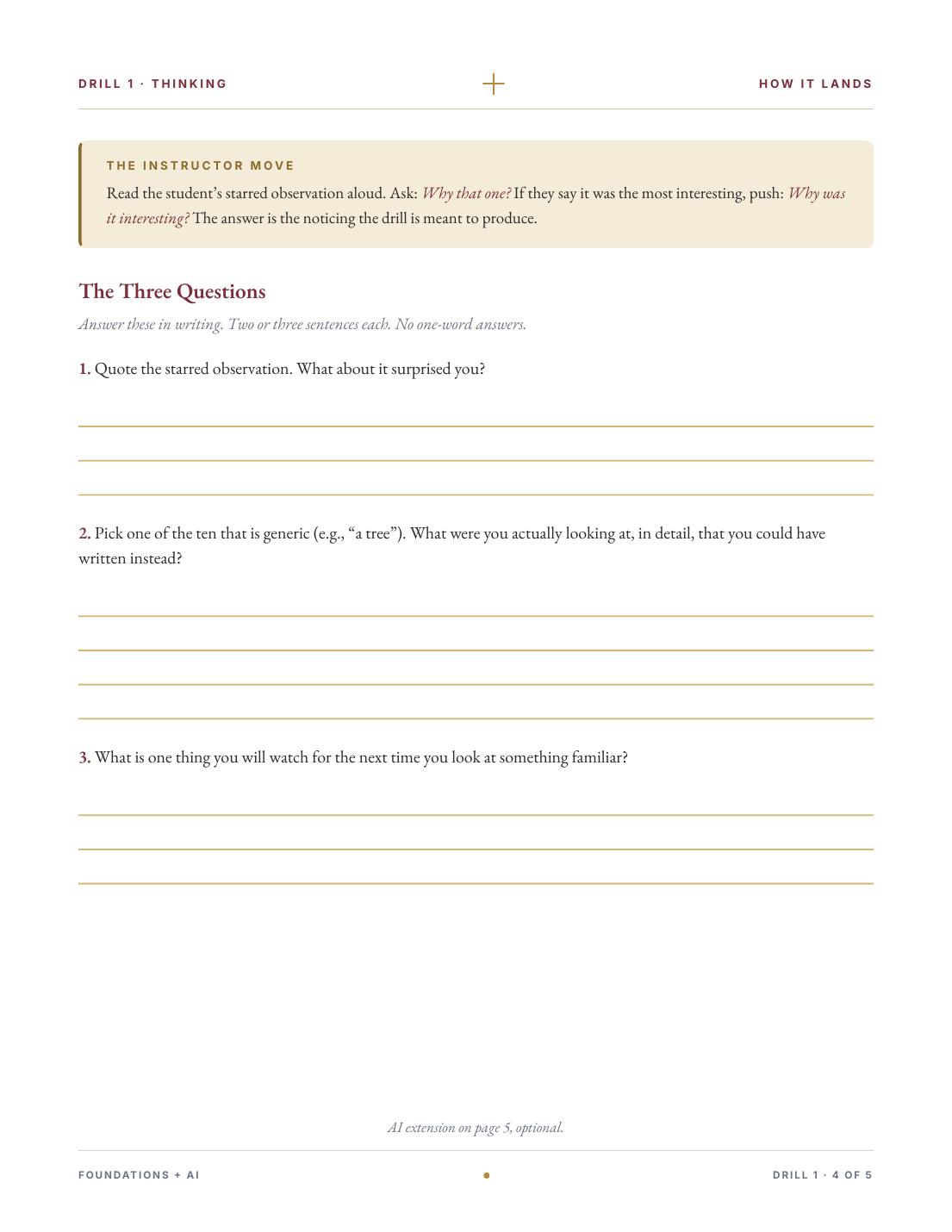
Page 4 of 5 · How It Lands
Then the optional AI session.
The AI Extension is page five of this drill. It is optional. It runs ten minutes. It is the same four-step shape in every drill. Ask. Question. Get questions. Write.
The student copies a short bounded prompt into the AI tool. The AI follows the prompt because the system prompt is installed. It does not write the new version. It points at three of the ten observations that name something specific, asks one short question back, and returns three questions when prompted to.
Then the student closes the AI tool and writes the new version on paper. The work returns to the page where it lives.
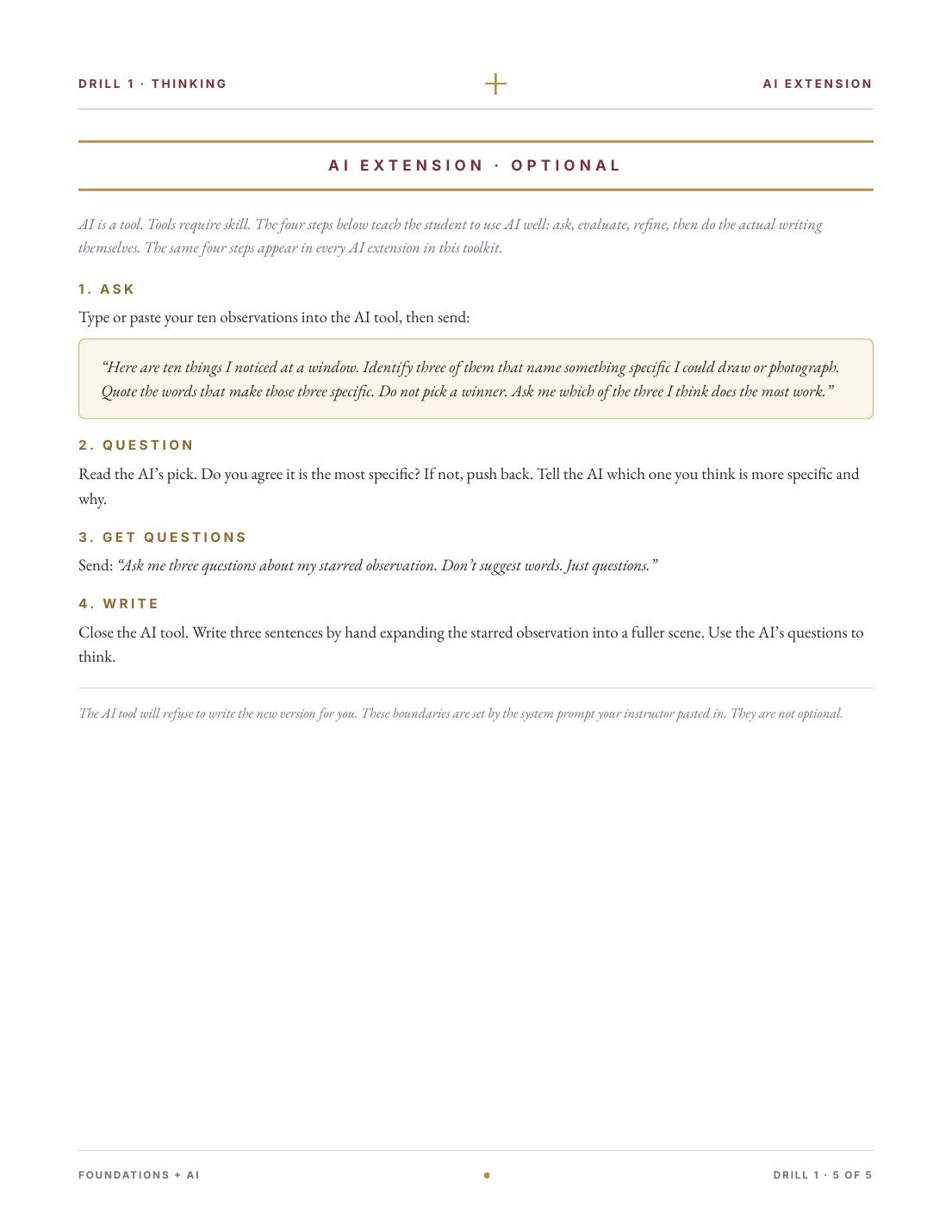
Page 5 of 5 · AI Extension · Optional
Three more drills, three more shapes.
A Comparison drill from Thinking. An Observation drill from Communicating. A Construction drill from Creating. Same spine. Different work.
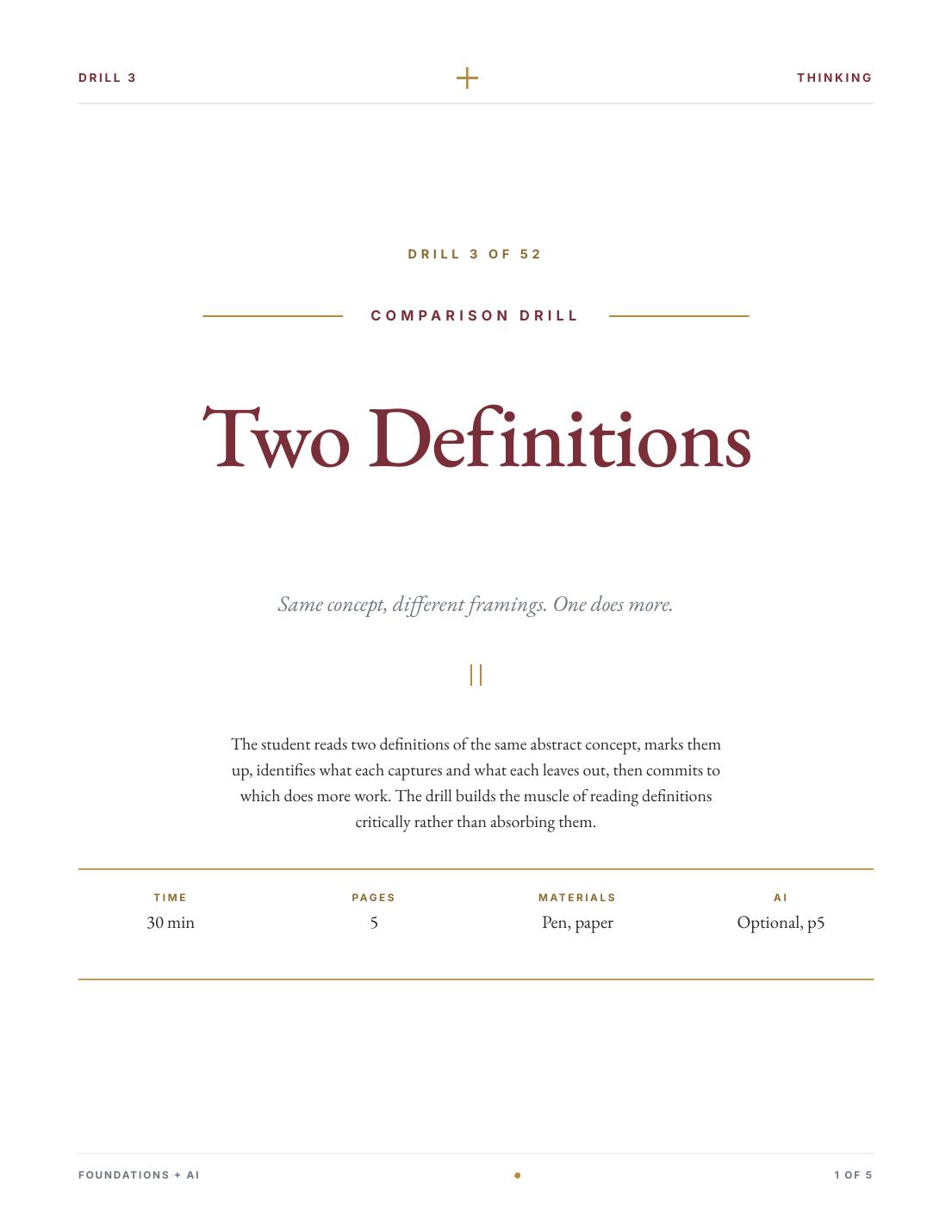
Drill 3 · Comparison · Thinking
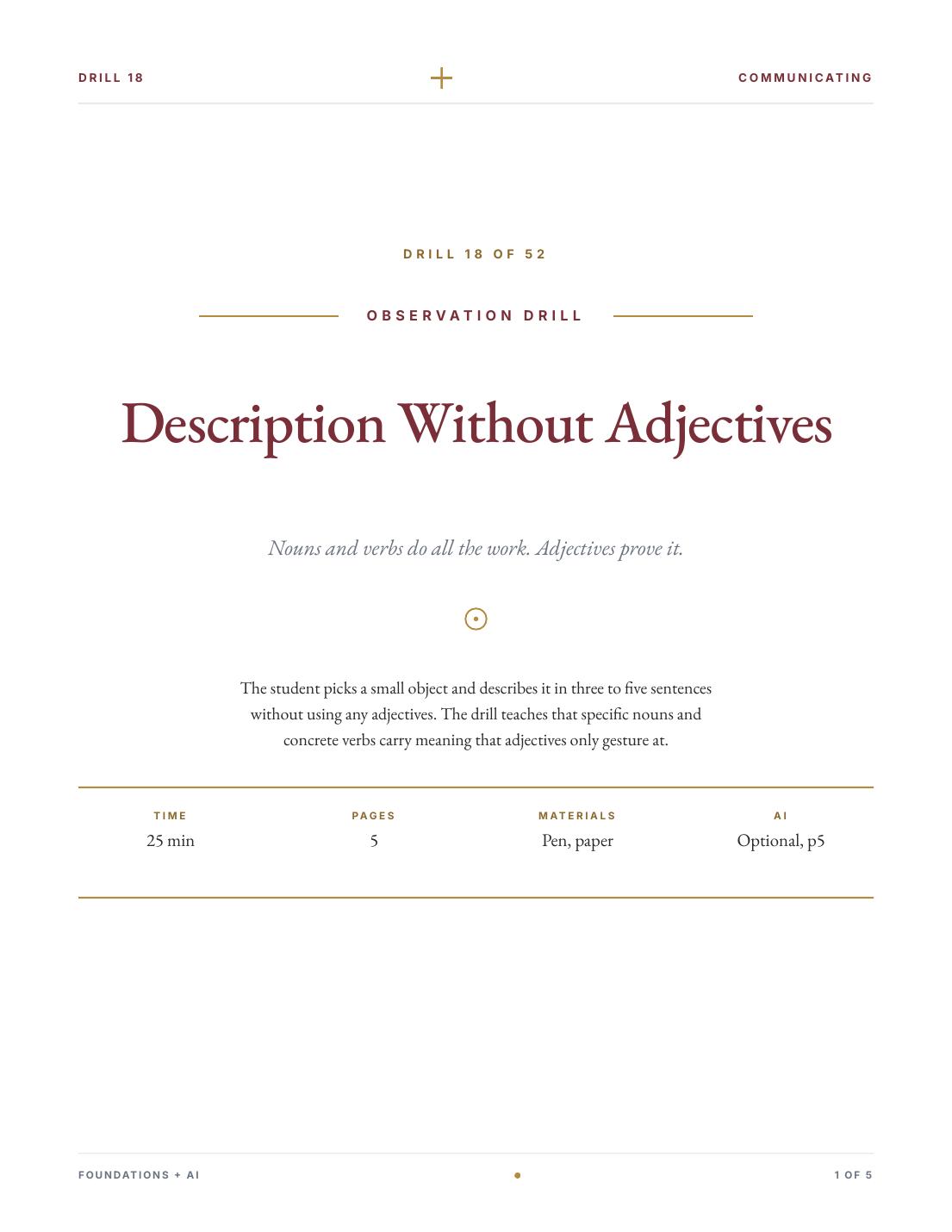
Drill 18 · Observation · Communicating
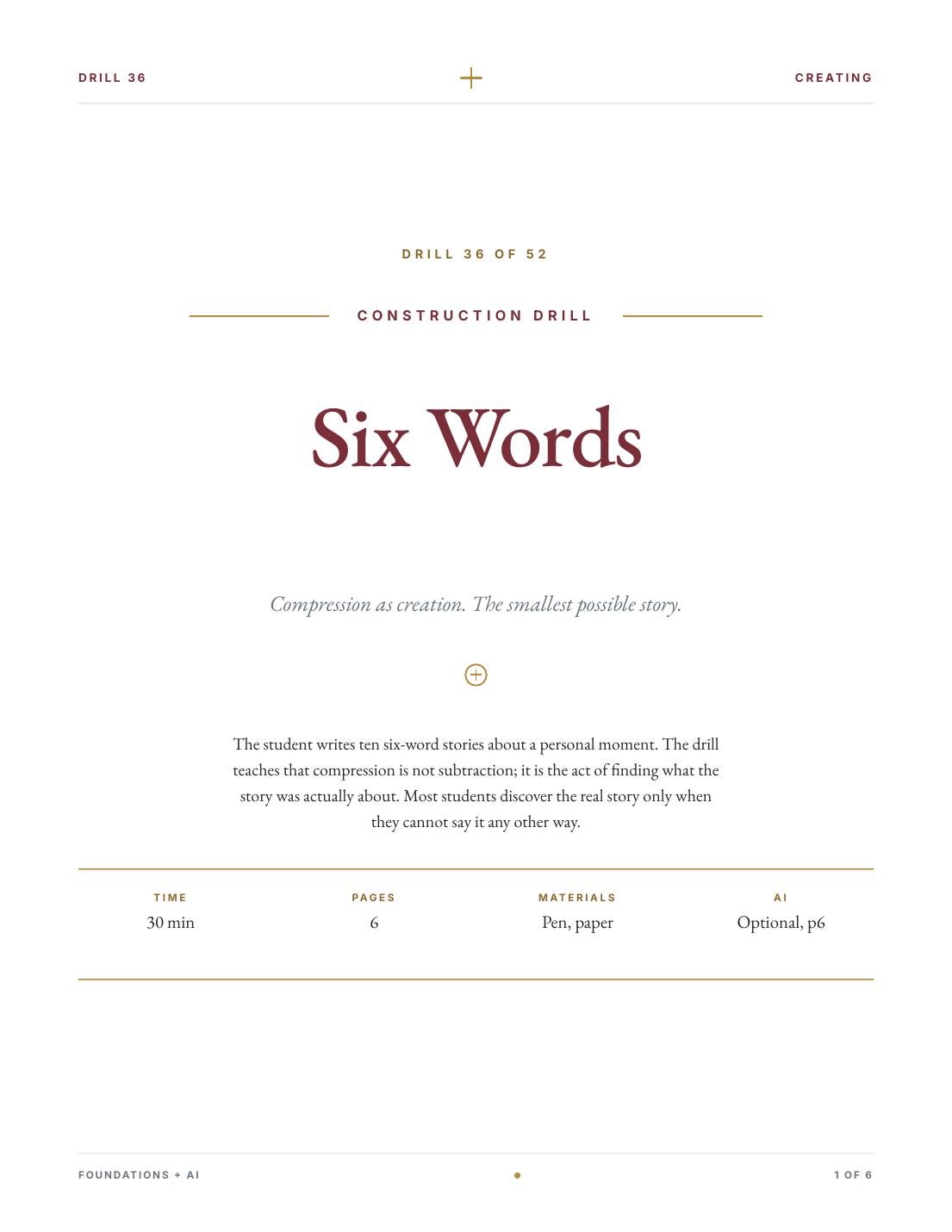
Drill 36 · Construction · Creating
Forty-eight more drills to choose from. One purchase. Print what you need.
Get the toolkit · $97The AI Setup chapter
Set up once. Then forget about it for a year.
Roughly thirty pages. The system prompt, the verification ritual, free-tier discipline, and what to do when AI behavior changes (it will, every few months).
Chapter opening
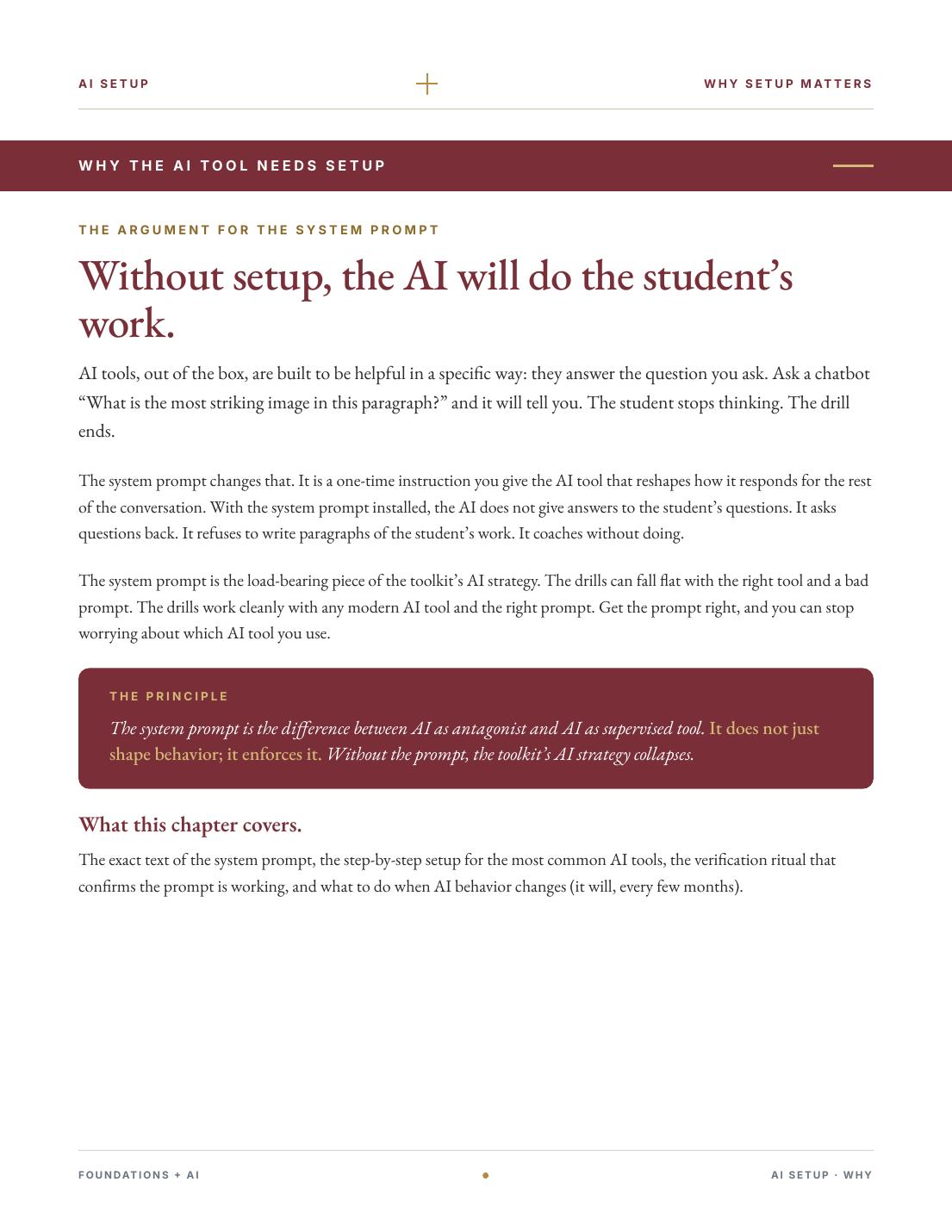
Why setup matters
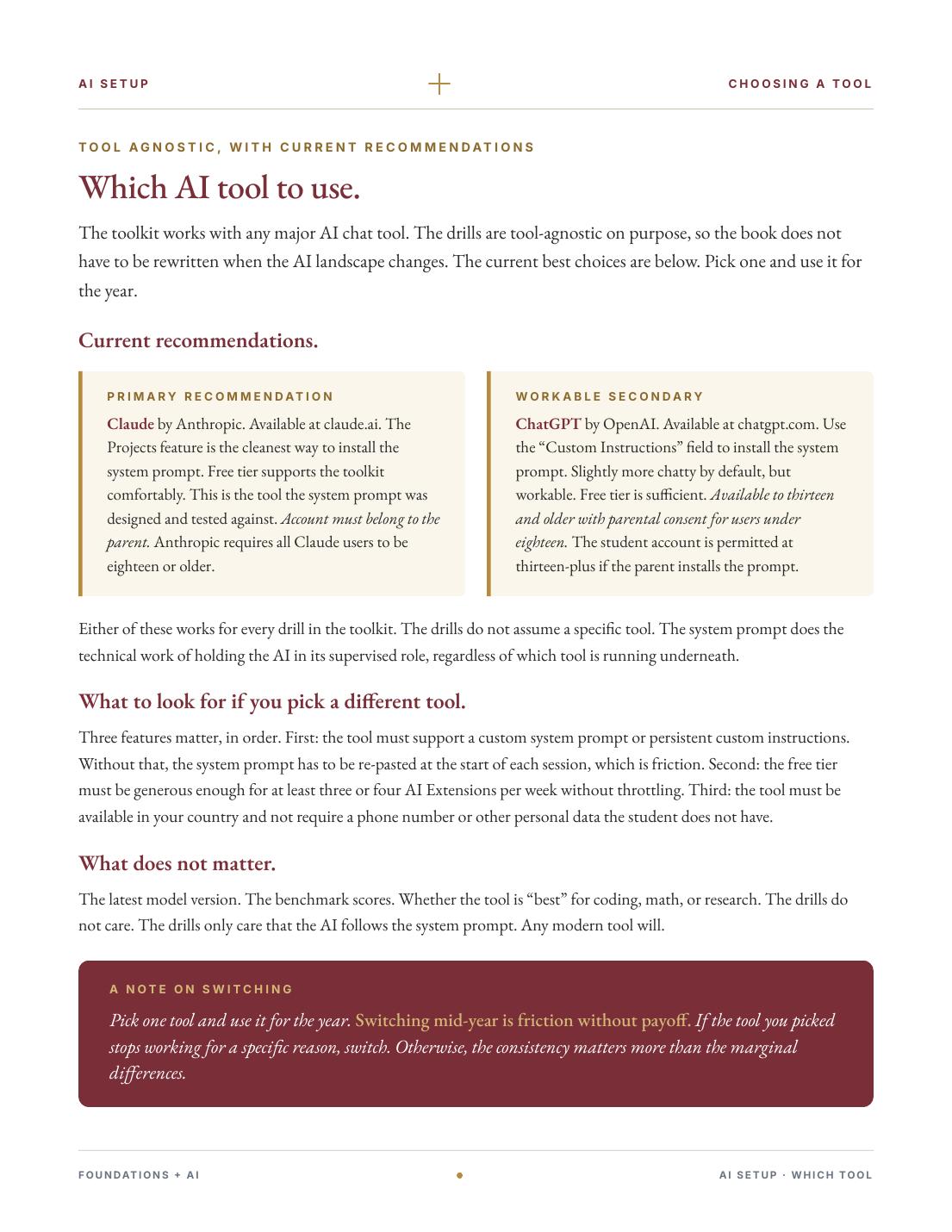
Which AI tool to use
Tool agnostic, with current recommendations.
The drills use the phrase "the AI tool you set up" rather than naming a specific provider. The system prompt is what holds the AI in its supervised role, regardless of which tool is running underneath. The chapter names current best choices (Claude as primary, ChatGPT as workable secondary) and gets updated every six to twelve months as the providers change pricing and capability.
Pick one tool. Use it for the year. Switching mid-year is friction without payoff.
For the instructor
Your job is small. The execution is everything.
The toolkit asks one specific thing of you per drill. Make one coaching move at one specific moment. The move itself is small. Holding the bar while the student writes the answer is harder than it sounds.
The Instructor's Toolkit chapter (roughly thirty-five pages) covers the three places your attention shows up. At the cover, you orient. At the choice point, you do nothing. At How It Lands, you make the move. There is also a chapter on what to do when the student writes "I dunno" and a chapter on group dynamics for microschool and co-op settings.
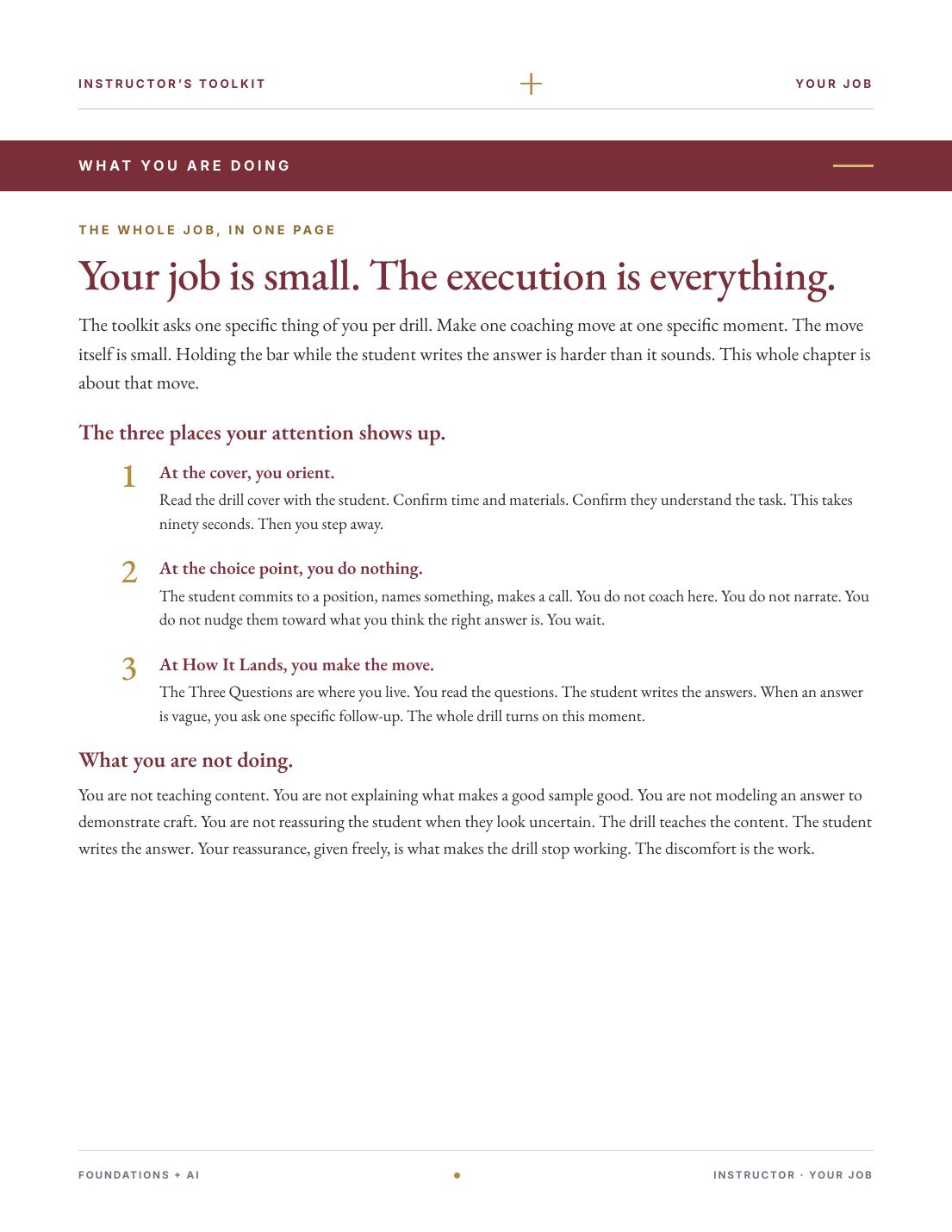
Instructor's Toolkit · Your job
Standards
Three frameworks. Demonstrable in every drill.
The fifty-two drills are mapped, drill by drill and standard by standard, to three professional frameworks. Common Core State Standards for English Language Arts, grades six through twelve. ISTE Standards for Students, which govern how students engage with technology. National School Library Standards from AASL, which govern inquiry, evaluation, and the ethics of working with information.
Appendix F is the full mapping. The standard is named, the grade band is specified, and the exact moment in the drill where the alignment lives is cited. The book cannot ship without this appendix complete.
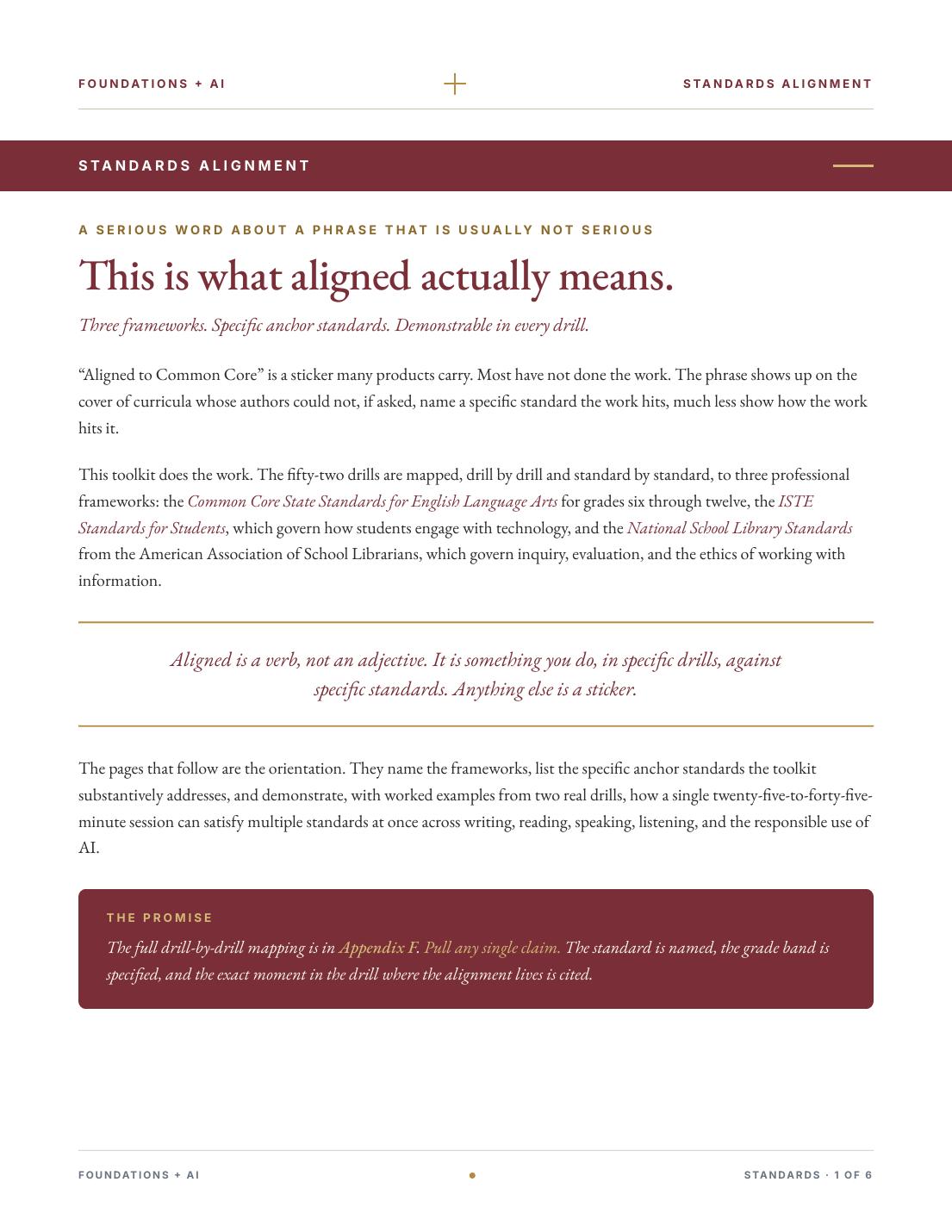
Standards Alignment chapter
You have seen the inside
Ready when you are.
$97 USD. Single household. Free updates while the AI tools update. The B7 access policy applies.