An instructor's toolkit · Grades 6 through 12
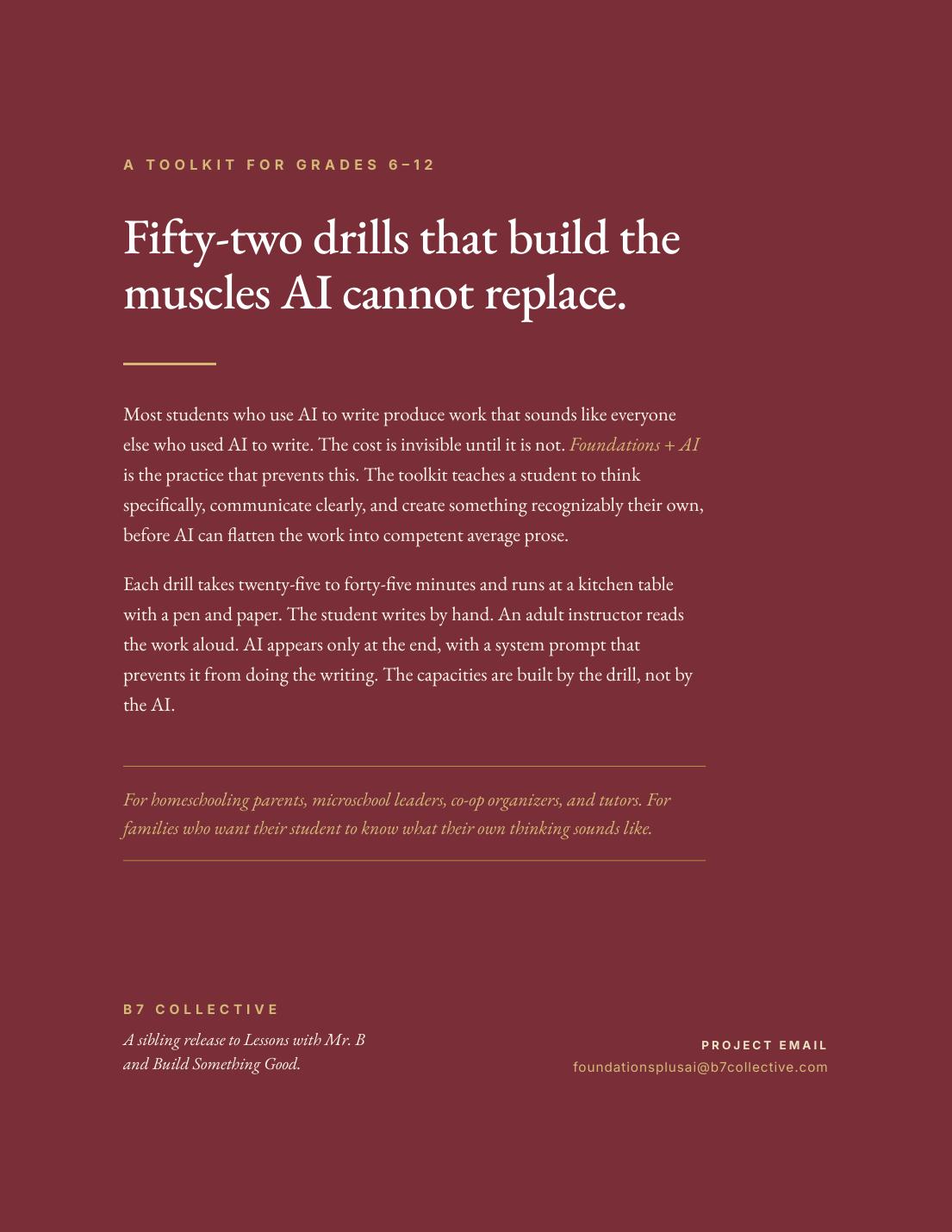
Fifty-two drills that build the muscles AI cannot replace.
A printable toolkit for homeschool parents, microschool teachers, co-op leaders, and tutors. Twenty-five to forty-five minutes per drill, at the kitchen table, with a pen and paper.
AI shows up at the end, with a system prompt that prevents it from doing the work for the student. The capacity gets built first. The tool comes after.
The argument
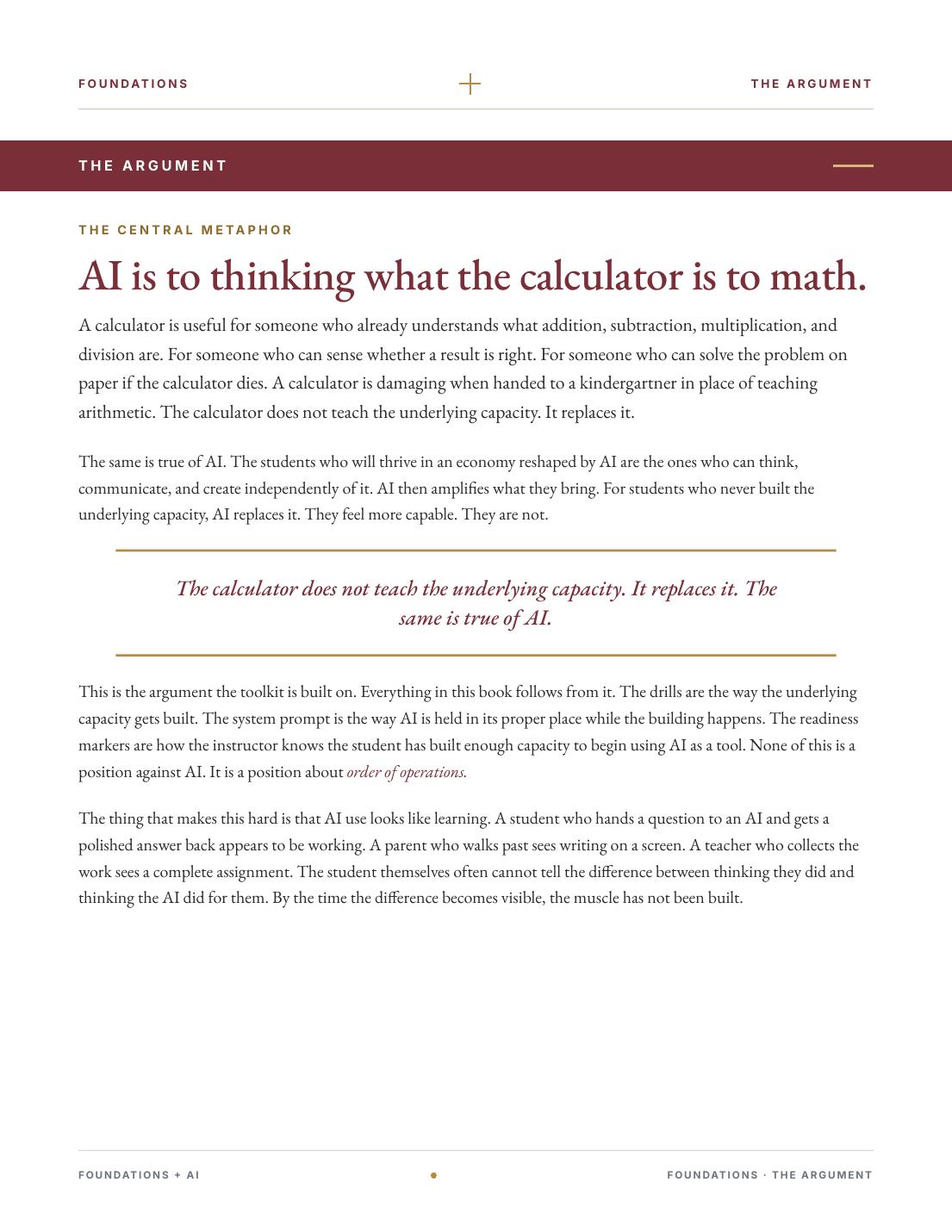
AI is to thinking what the calculator is to math.
A calculator is useful for someone who already understands what addition, subtraction, multiplication, and division are. For someone who can sense whether a result is right. For someone who can solve the problem on paper if the calculator dies.
A calculator is damaging when handed to a kindergartner in place of teaching arithmetic. The calculator does not teach the underlying capacity. It replaces it.
The same is true of AI. The students who will thrive in an economy reshaped by AI are the ones who can think, communicate, and create independently of it. AI then amplifies what they bring. For students who never built the underlying capacity, AI replaces it. They feel more capable. They are not.
A drill, in this toolkit, is a focused practice session. Twenty-five to forty-five minutes on a single small skill. The same way a basketball coach drills footwork, this toolkit drills the moves of careful thinking, clear writing, and honest revision.
From the front matter · The argument
The calculator does not teach the underlying capacity. It replaces it. The same is true of AI.
What you get
A 395-page toolkit. Print what you need.
Foundations + AI ships as a single PDF. Print drills as you run them. The student writes by hand.
How a year of work fits
Most families run twelve to twenty-five drills in a year and skip the rest.
The drills do not depend on each other in sequence. If you miss a week, do not catch up. Skip and continue. The toolkit is a curated year of available work, not a year-long program you have to finish.
Some drills land in twenty-five minutes. Some run forty-five. Each one is self-contained. Each one ends with three written questions the student answers in two or three sentences each. Each one names one specific moment for you, the instructor, to make one specific coaching move.
The contents
The structure
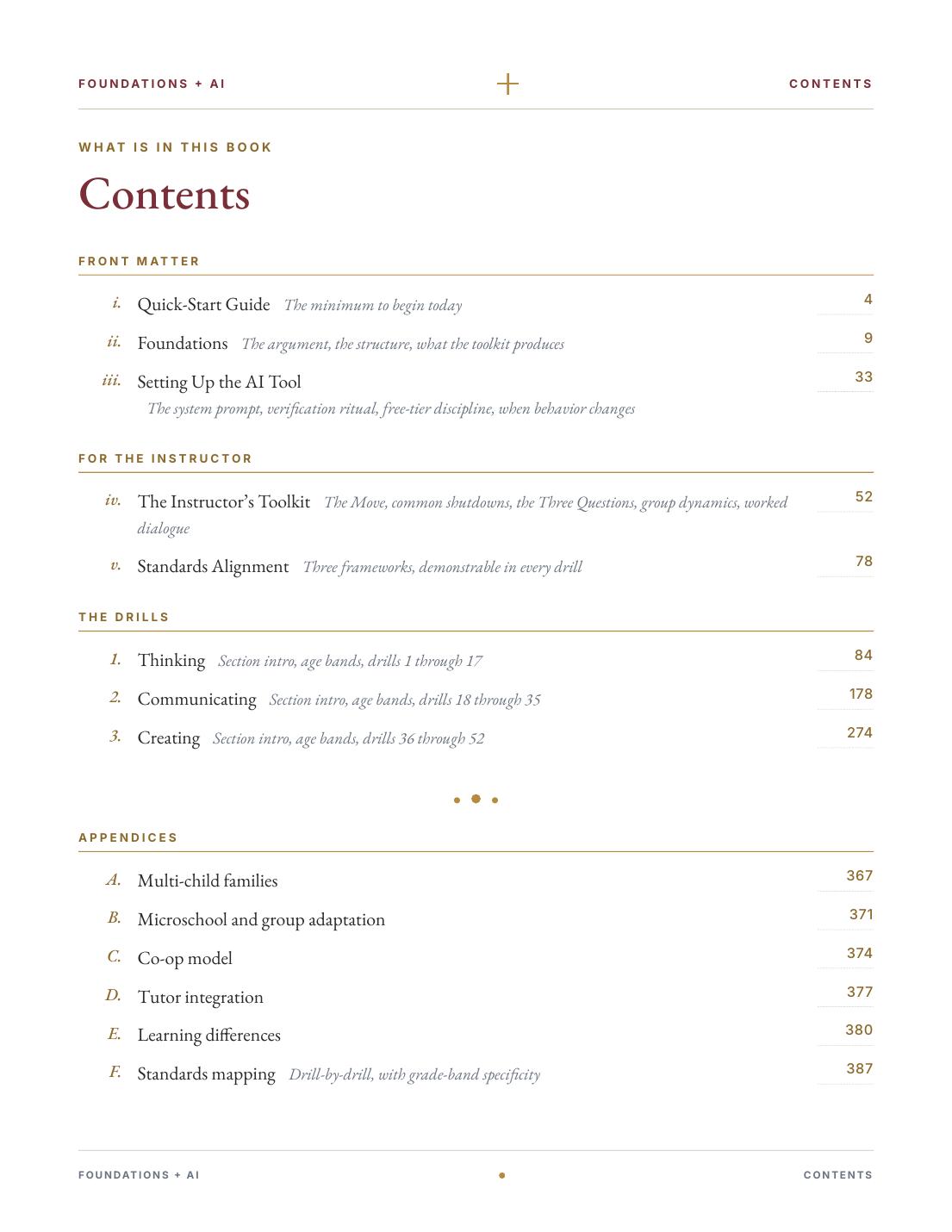
Three capacities. One year of work, available to skip.
Each capacity has its own section. Each section opens with an essay and an age-band reference page. The drills inside are not strictly sequenced. Pick one, print it, run it.
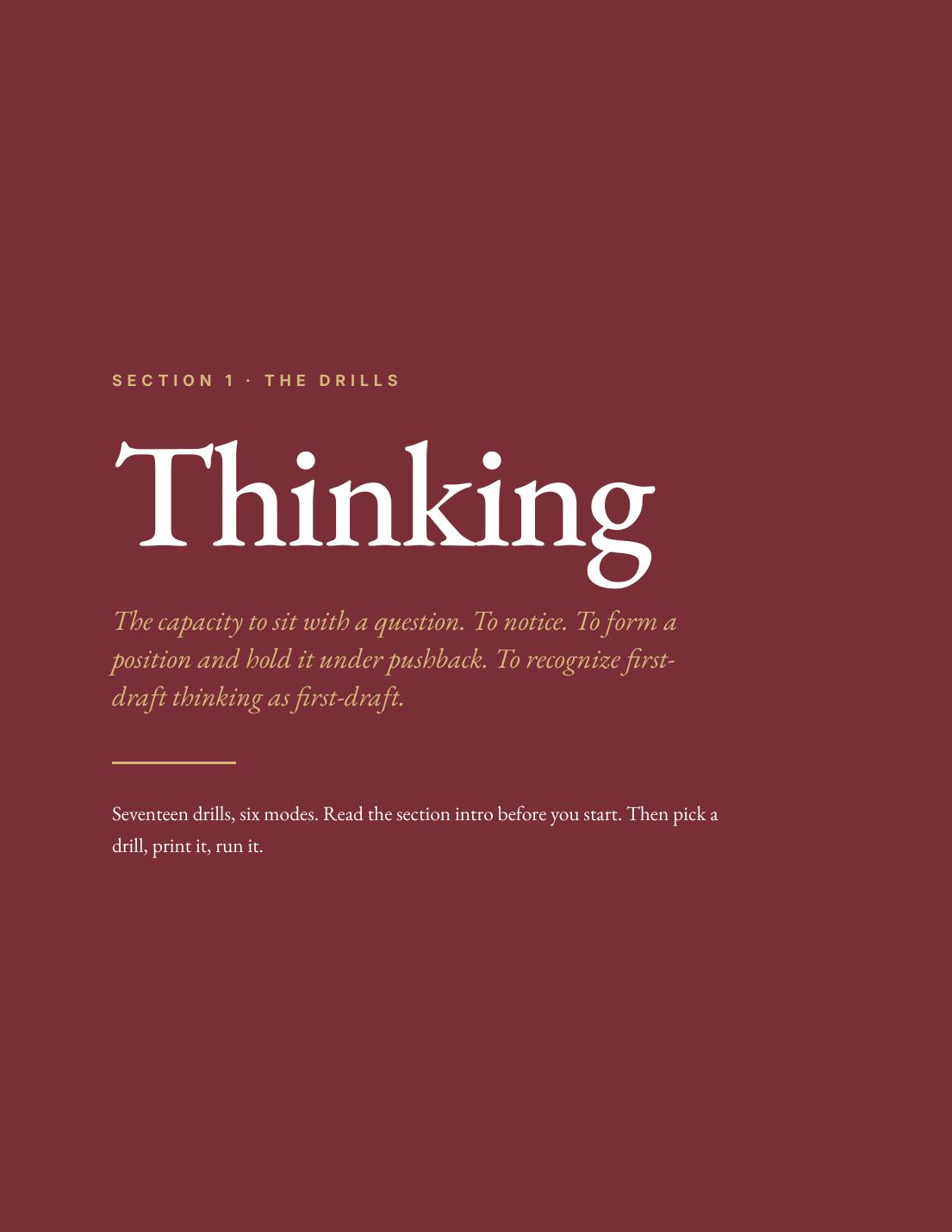
Section 1 · 17 drills
Thinking
The capacity to sit with a question. To notice. To form a position and hold it under pushback. To recognize first-draft thinking as first-draft.
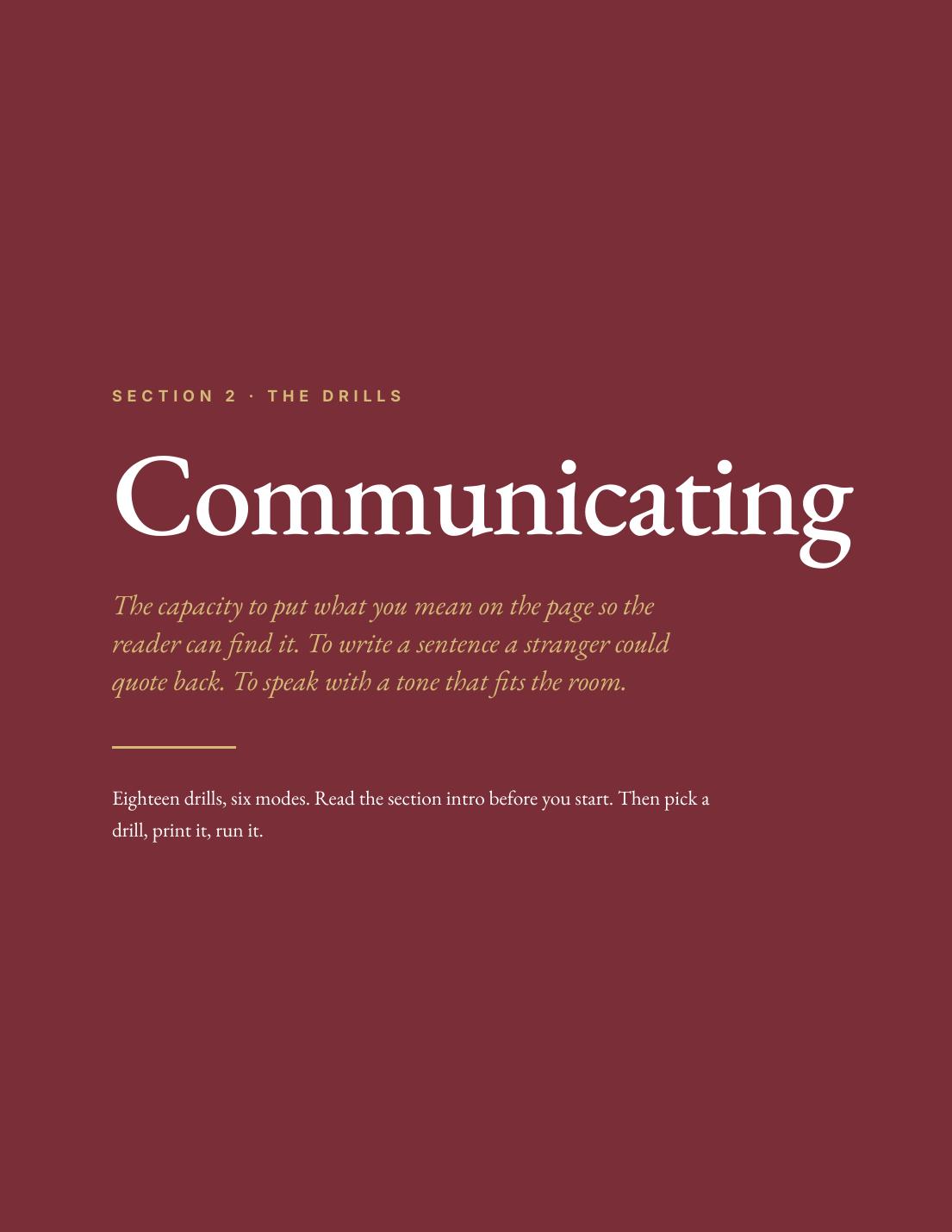
Section 2 · 18 drills
Communicating
The capacity to put what you mean on the page so a reader can find it. To write a sentence a stranger could quote back. To speak with a tone that fits the room.
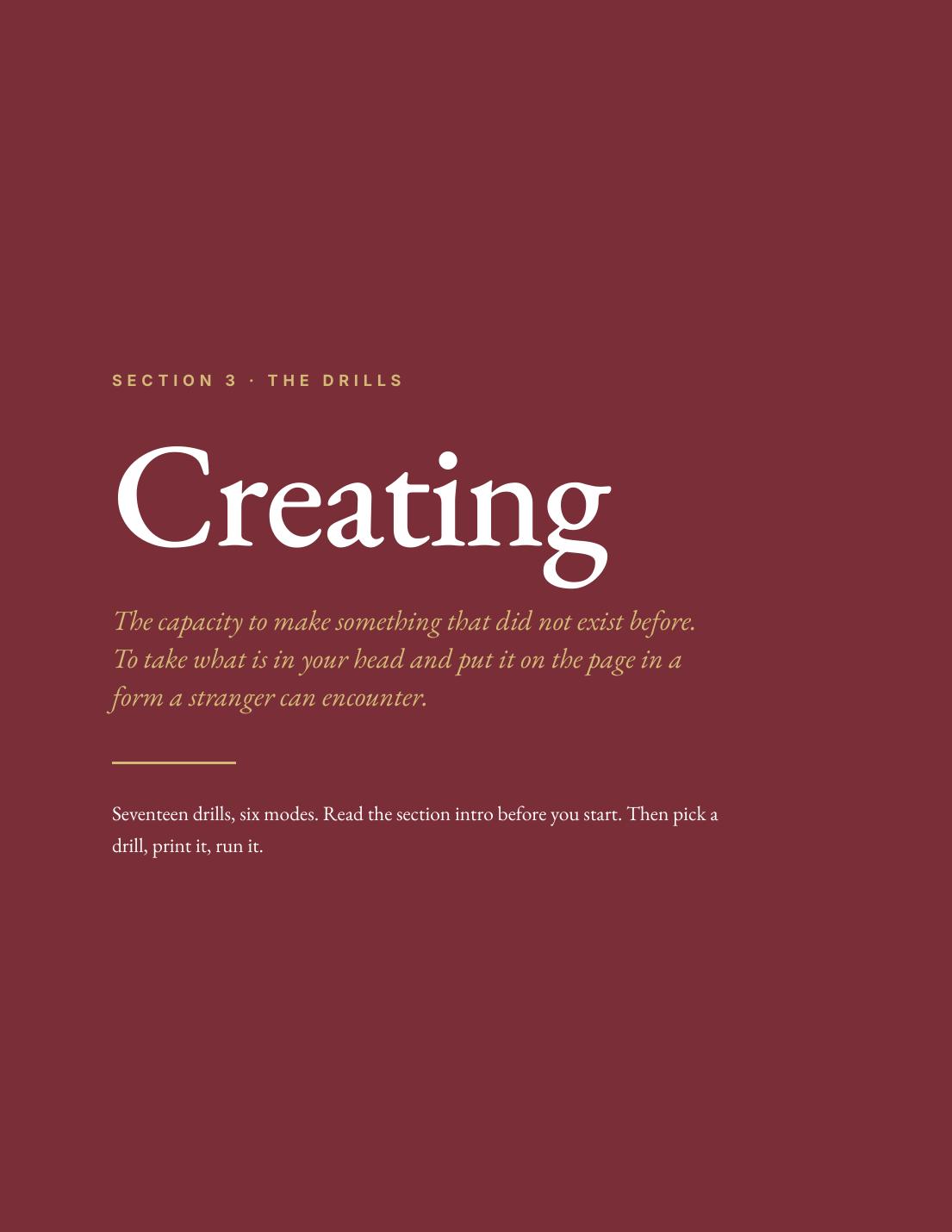
Section 3 · 17 drills
Creating
The capacity to make something that did not exist before. To take what is in your head and put it on the page in a form a stranger can encounter.
See every section opener and a sample drill, page by page.
Inside the bookWhat a drill looks like
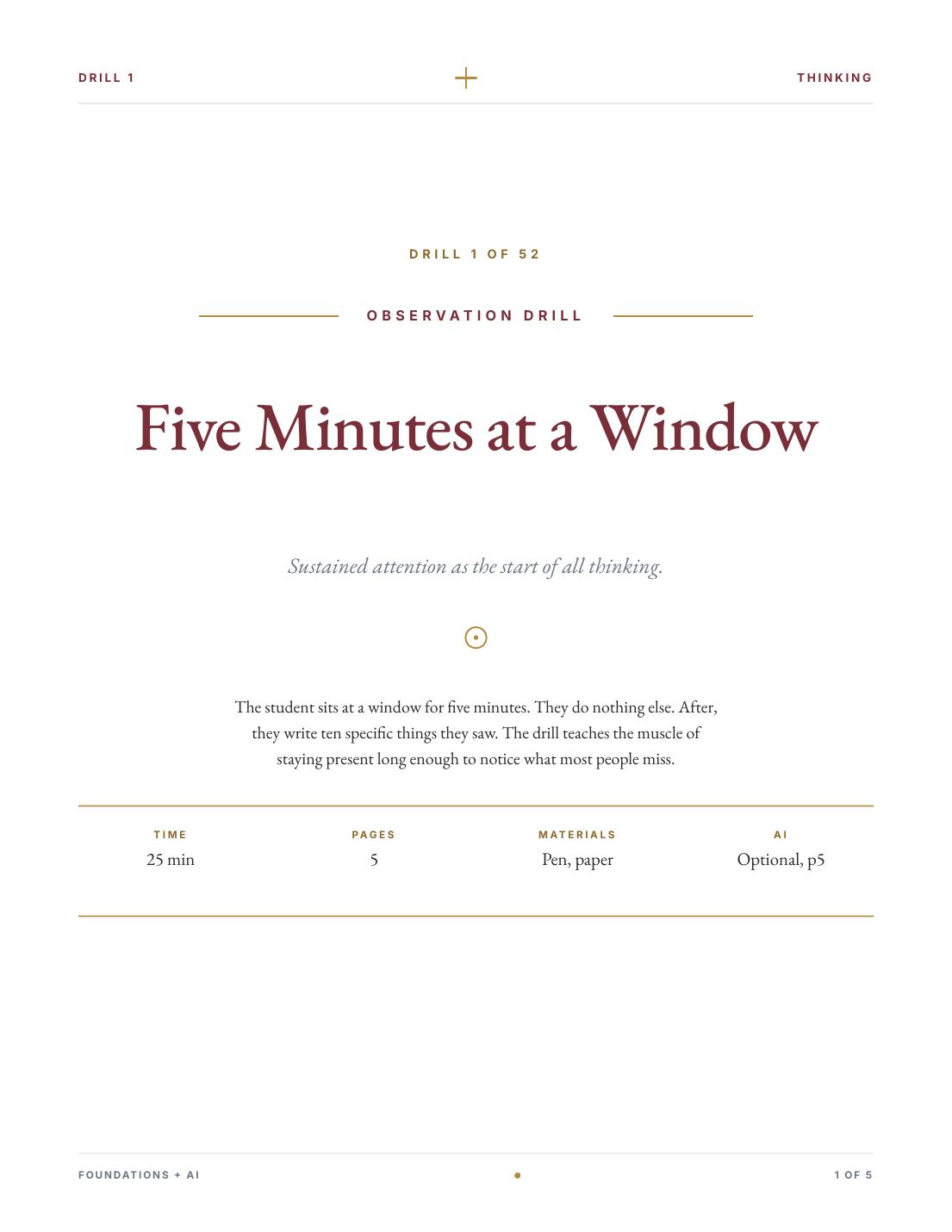
Five Minutes at a Window.
Drill 1 of 52. Twenty-five minutes. Pen and paper. An optional ten-minute AI session at the end.
The student sits at a window for five minutes and does nothing else. After, they write ten specific things they saw.
"A red truck idling at the corner with the driver-side mirror folded in" earns the credit. "A truck on the street" does not.
The drill teaches the muscle of staying present long enough to notice what most people miss. One of the ten observations gets starred. The instructor reads the starred one back and asks one specific question: why that one?
The drill ends with three written questions the student answers in two or three sentences each. The instructor asks the question. The student writes the answer. Nobody talks the answer out of them.
Every drill follows the same six-element spine. The cover. The setup. The doing, with the choice point named. What good looks like. What slop looks like. How it lands. The spine is the consistency. The drill mode is the variation.
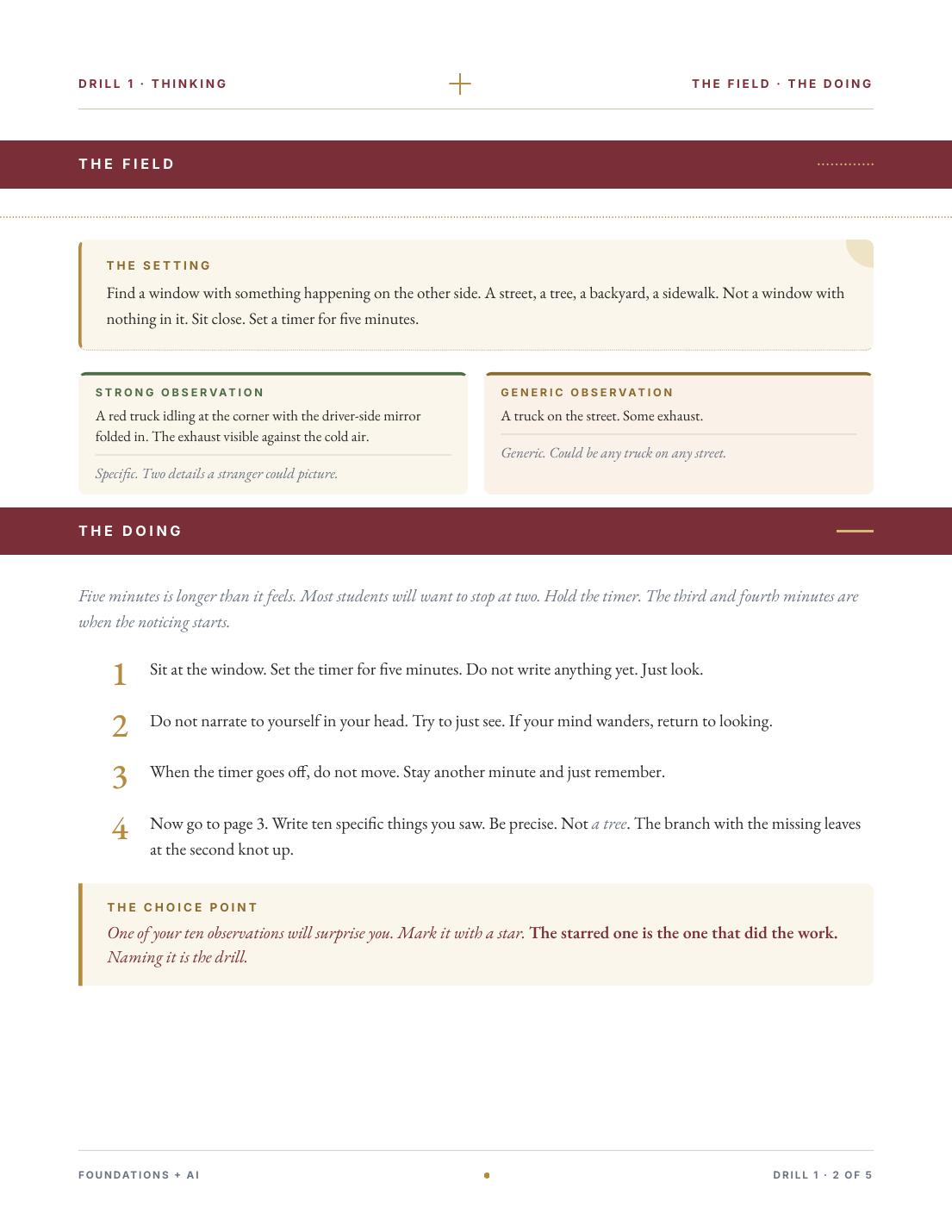
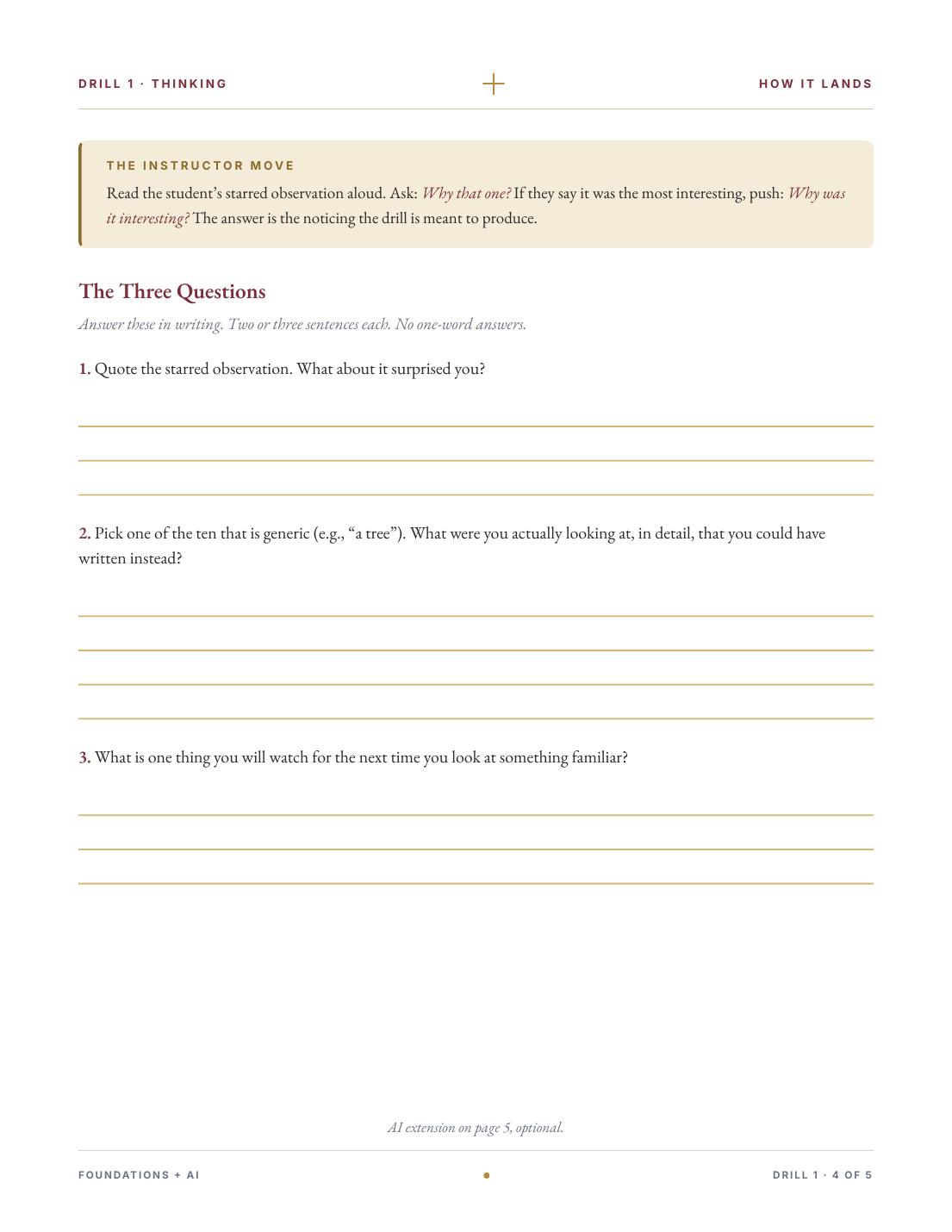
Three pages from Drill 1 · Hover or tap to lift
Six modes, one spine
Different shapes for different work.
A drill is shaped by what it teaches. Each of the six modes uses a different page architecture. The student is doing different work, so the page asks for it differently.
Drill 1 · Observation
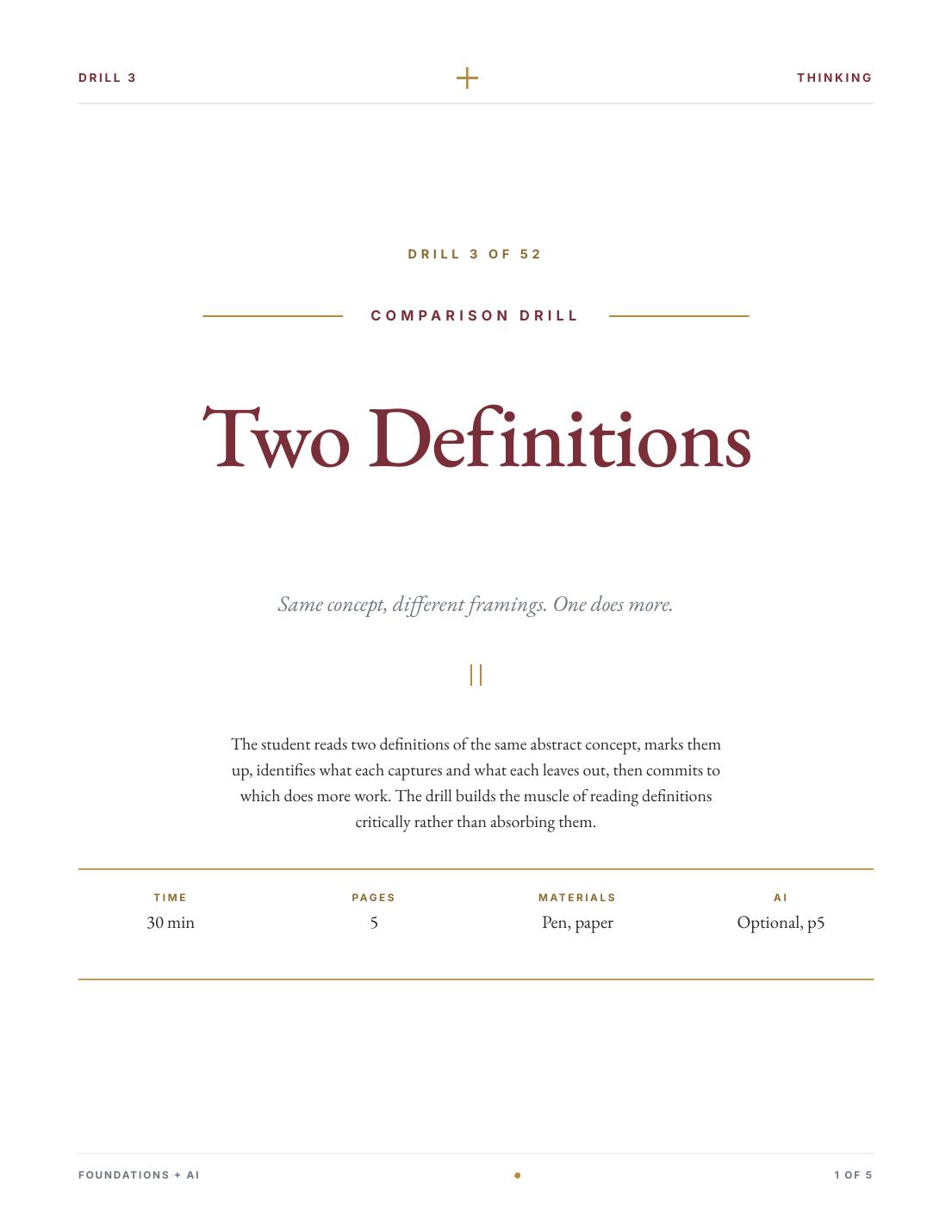
Drill 3 · Comparison
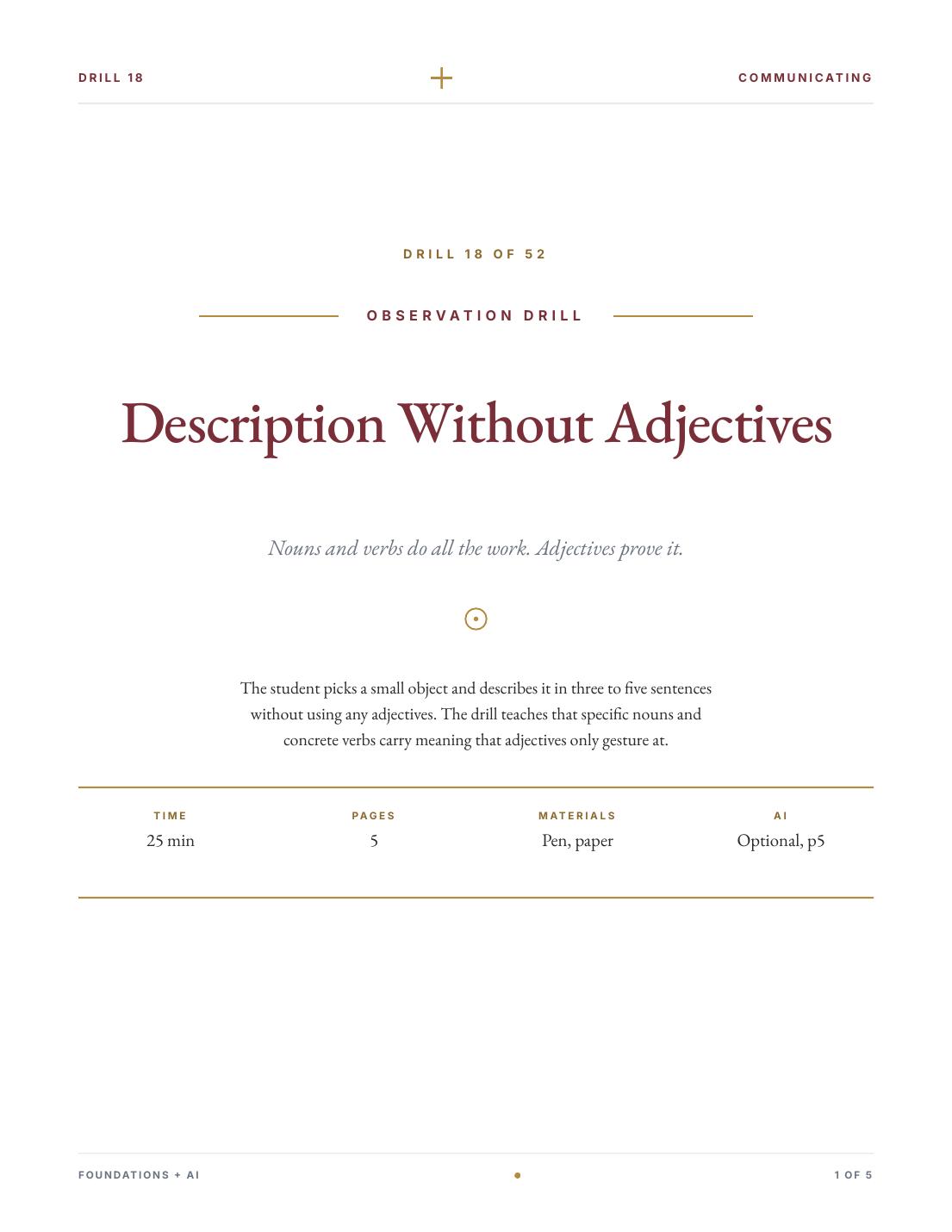
Drill 18 · Observation
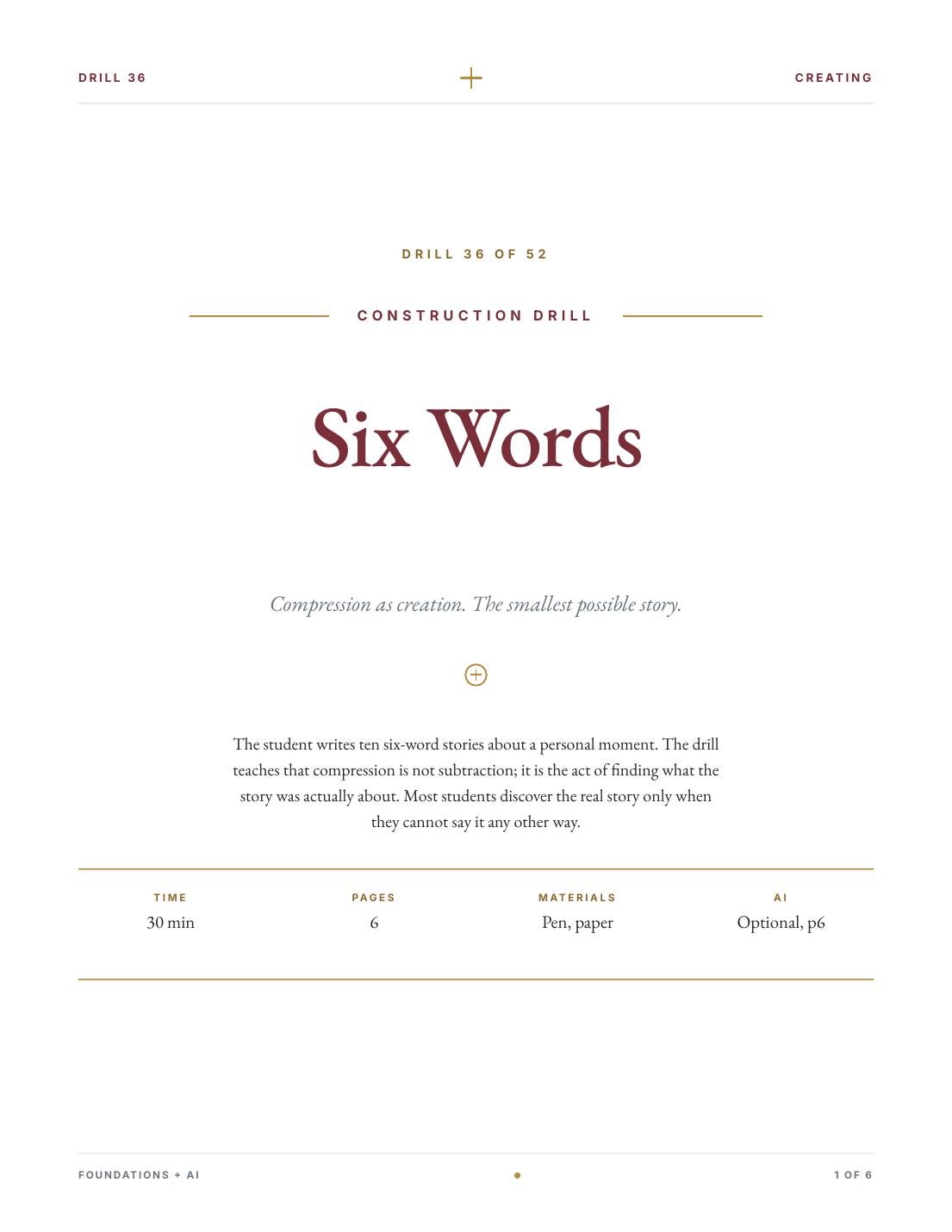
Drill 36 · Construction
How AI fits
AI shows up at the end. Supervised.
Most curricula either pretend AI is not here, or hand it over to the student with no scaffolding. This toolkit does neither.
The toolkit gives you a system prompt. A system prompt is one block of text you paste once into an AI tool's project feature. From then on, the tool follows those instructions for every conversation.
With this prompt installed, the AI refuses to write paragraphs for the student. It refuses to generate images. It asks one question at a time. It stays inside the four-step workflow each drill specifies.
When the student opens an AI Extension at the end of a drill, the AI is already configured to support the work without doing it. You set it up once. Then forget about it for a year.
An AI Extension is the optional ten-minute AI session that comes at the end of most drills. The student types into the AI tool, the AI asks questions back, and the student closes the tool and writes the new version by hand.
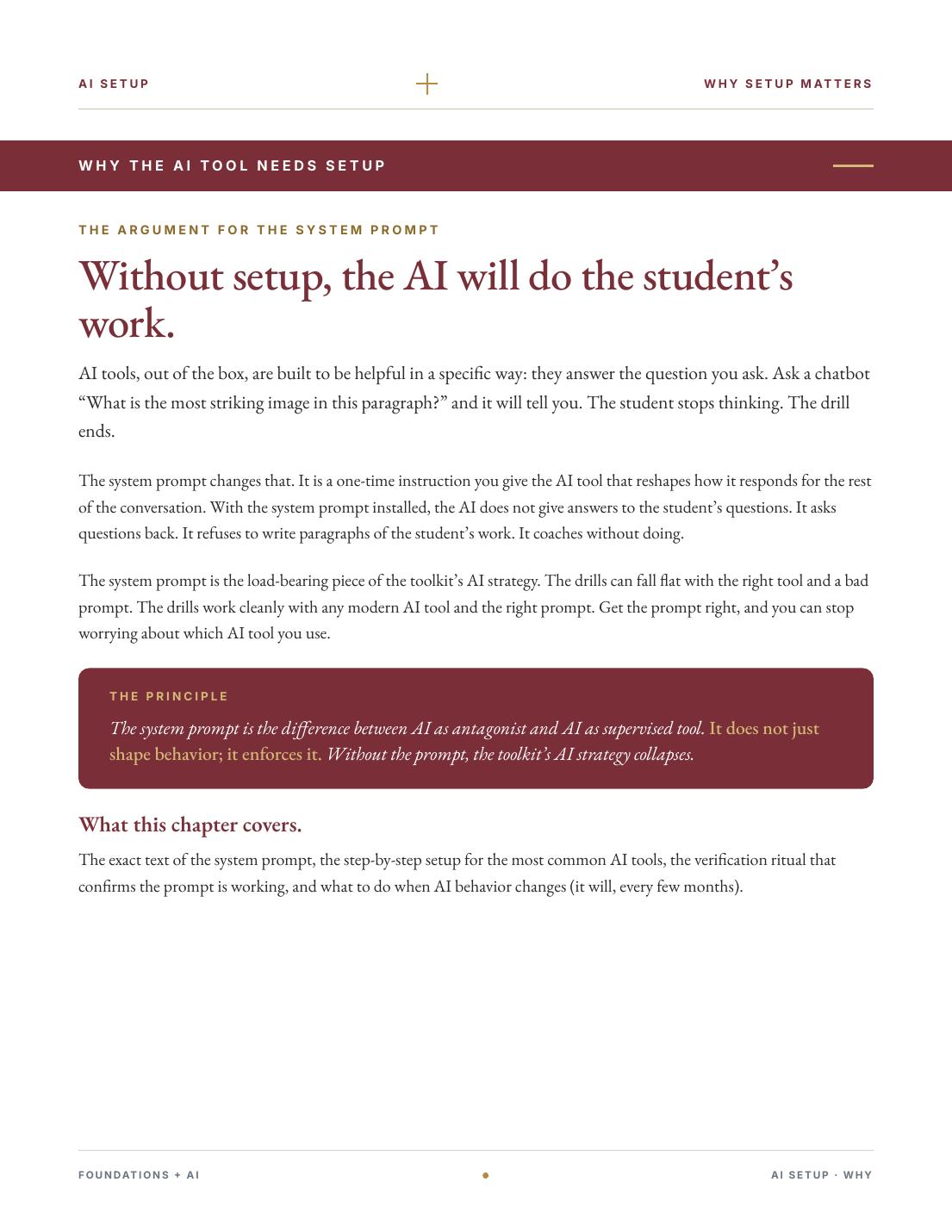
From the AI Setup chapter
The four steps, in every drill.
A bounded prompt provided as exact text the student copies into the AI tool.
The student reads the response, evaluates it, and pushes back where they disagree.
The student asks the AI for three questions about their thinking. Not for answers.
The student closes the AI tool. Returns to paper. Writes the new work in their own words, by hand.
Who uses it
Built for the kitchen table. Adapted for everywhere else.
The primary buyer is the homeschool parent running drills with their own student. Every other instructor type has a dedicated appendix.
Homeschool parent
The primary user. Runs drills with one or more middle or high schoolers around the kitchen table. The toolkit is shaped for you. Multi-child families have their own appendix on differentiation.
Microschool teacher
Six to fifteen students. Appendix B covers differentiation, anti-copying strategies, share-without-copying protocols, and pacing for school-day integration.
Co-op leader
Mixed family practices around AI. Appendix C covers which drill components work in a group meeting and which travel home as homework.
Private tutor
Sixty to ninety-minute sessions. Appendix D covers chaining models and the positioning narrative for selling the toolkit to parents.
Alignment
Aligned is a verb, not an adjective.
"Aligned to Common Core" is a sticker many products carry. Most have not done the work. Foundations + AI maps every drill to specific anchor standards from three frameworks. The standard is named, the grade band is specified, and the exact moment in the drill where the alignment lives is cited.
Full drill-by-drill mapping in Appendix F.
Get the toolkit
One purchase. One household. One year of practice you do not have to finish.
$97 USD. Single household. Free updates while the AI tools update.
The B7 access policy applies: if cost is in the way, take it anyway. Email hello@b7collective.com and we will work it out.